TEN YEARS OF AUSTRALIAN FOLKLORE
Ian Turner
Australian Tradition, March, 1966, pp 7/8 and June, 1966, pp 19-21
Published with permission of Steve Bullock, President Victorian Folk Music Club.
People have, of course, been interested in Australian folklore for a long time. (To make my position clear – although I’m afraid it won’t forestall the arguments – what I mean by folklore is popular song, verse, story, language, belief and behaviour, which exist in oral tradition.) The interest is not new; but ten years or so ago, individual interest first found an organised expression with the creation of Folklore Societies in Sydney (December, 1953) and Melbourne (August, 1955).
The sources of interest in Australian folklore were, I think, three. First, in order of time, was nationalism – whether in the form of a nostalgic sentiment for an idyllic past, or of the search for a foundation on which to build a national culture. It was nationalism which inspired the early collecting and publishing of Banjo Paterson, whose Old Bush Songs appeared in a number of editions between 1905 and 1931; Louis Lavater and Vance Palmer, both of whom published folios of bush songs; Dr. Percy Jones and John Manifold, who began collecting in the ‘30s; Alan Marshall, whose main interest has been in bush yarns, superstitions and other bush lore. The concern of the nationalists was for the preservation of tradition and the development of an indigenous culture.

Secondly, there was radicalism. There is sound precedent for this. William Morris, Cecil Sharp, and other leaders of the 19th century British folksong revival, were radicals of their time. In Australia, most of those with folklore interests have had radical inclinations; Julian Stuart, who published a series of fascinating articles on bush traditions in The Worker, in the ‘20s, is a good example. Indeed, one should expect this, for folklore concerns the culture and traditions of common people, and these are generally radical and democratic in spirit. No one writes folk songs about the directors of the B.H.P. except to abuse them.
In recent years, the radical interest in folklore has also had international implications. To many, the revival of interest in Australian folksong was a defence against the domination of popular art and entertainment by the impoverished products of Hollywood and Tin Pan Alley. (Unfortunately, because of this, folklore sometimes got entangled in the cold war.) The radical interest in folksong was concerned with the “protest” element, and bordered on nationalism.
Thirdly, there was a musical line of interest - commonly from jazz, through blues and Negro folksong, to white American folksong (Ives, Guthrie, Seeger, the Almanacs) and other folksong, including Australian. The musical interest was in the folk sounds – although, because so much of Negro song was protest, it bordered on the radical.
These different starting points were the origin of many of the later arguments among those interested in Australian folklore. The “musicals” distrusted the historical and political purism of the radicals and nationalists. The radicals distrusted the dilettantism of the “musicals”. The nationalists distrusted the motives of the radicals. (For the record, the point should be made that the radicals were often in trouble with their own side, too—their enthusiasm for Australian folklore was often seen as a nationalist distraction from serious political affairs.)
There were many harbingers of the start made on organised folklore studies in 1953-55. Max Brown and Frank Clune, researching on bushranging, uncovered some of the bushranger songs and included them in their books.
Geoffrey Ingleton was researching TruePatriots All, and Bill Wannan The Australian. Douglas Stewart and Nancy Keesing were collecting material for Australian Bush Ballads and their expanded edition of Old Bush Songs.

The National University gave Russel Ward a scholarship to collect the material for his splendid pioneering social history, The Australian Legend.

The first public performances of Australian ballads gave this growing interest a new direction. John Manifold led a group of Brisbane singers in presenting Australian ballads at a youth carnival in Sydney in 1952; soon after, he began publishing (with Ron Edwards, who was then operating his Ram’s Skull Press from his home in Ferntree Gully) the broadsheet Bandicoot Ballads. A year or so
later, the Melbourne and Sydney New Theatres presented Dick Diamond’s Reedy River. This had a dramatic effect – lots of people realised for the first time that Australian ballads were good to sing and listen to.


Then, in Sydney in December, 1953, the Sydney Folklore Society was formed at the instigation of Edgar Waters, who has since become Australia’s most distinguished folksong scholar. (Soon after this. Waters went to England where he worked for some time with A. L. Lloyd and Alan Lomax.)
I proposed the formation of a Victorian Folklore Society to a group of people – including, I think, Wendy Lowenstein, Norm. O’Connor – some time in 1954. It may be of some use to put on record how my interest developed. I had been a jazz fan since schooldays, and had heard some (although not much was yet available in Australia) blues and Negro folksong. After the war, I became interested in protest songs – Joe Hill, the Spanish Civil War songs, the C.I.O, songs. A journalist friend brought back from America records of the Almanac Singers, including pieces like “Talking Union”. In 1950, in Warsaw, I heard Betty Sanders, a young American singer, sing “Johnny, I Hardly Knew You” and other songs popularised by the American People’s Artists. Back in Australia, I tried to form an organisation to issue discs of folk and protest songs, and failed dismally. On the left, this was a time of intense interest in national culture. In 1954, Steve Murray-Smith (with the support of the Realist Writers) launched Overland. I did a bit of collecting, making a couple of tapes of an old wool-classer, Jim Seymour, of Gippsland. This, and what I had heard of the work of the Sydney collectors, convinced me of the need for a Folklore Society. The first meeting came to nothing; nobody was prepared to be secretary. Later, Wendy Lowenstein took the job on, and got the organisation off the ground in August, 1955.
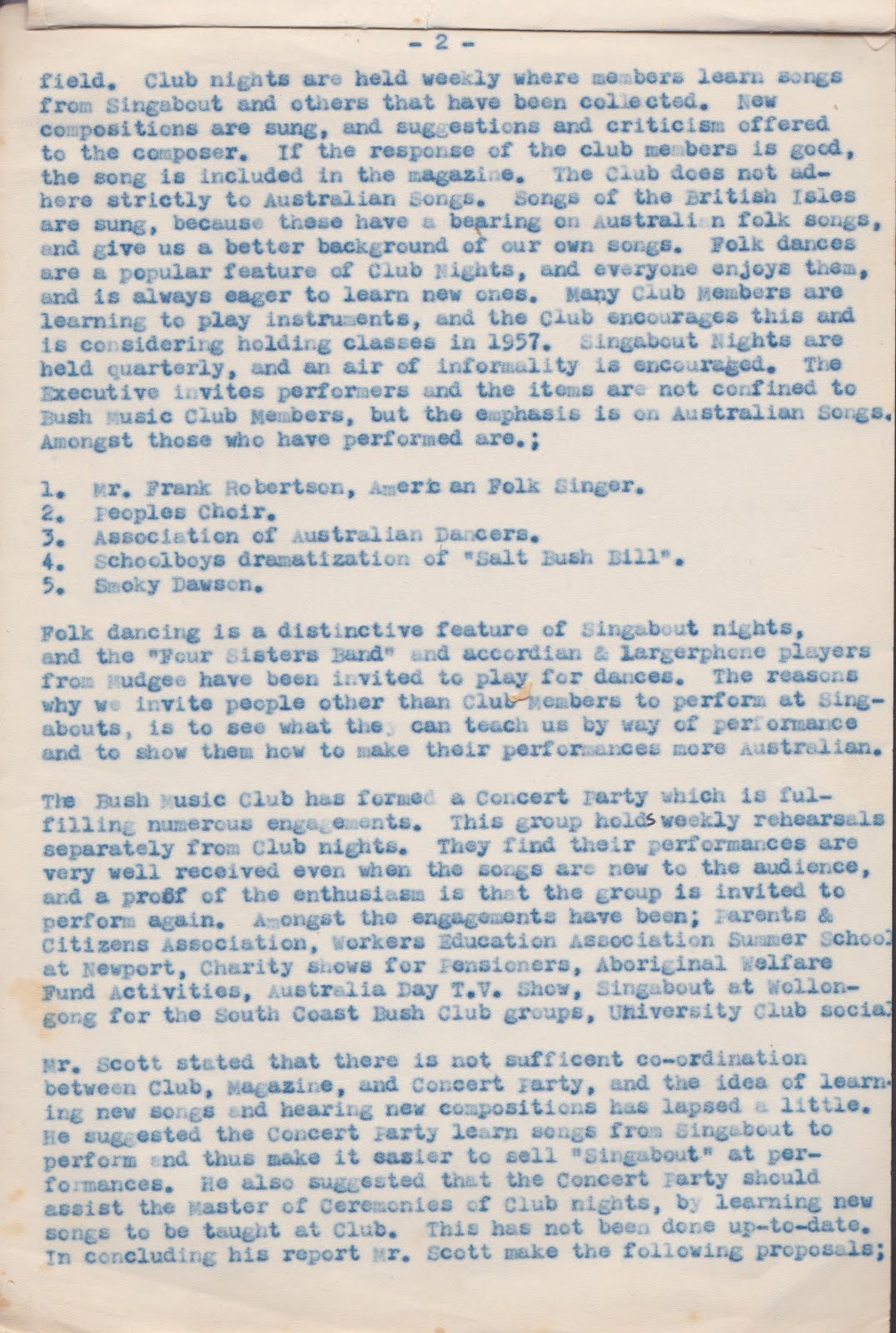
The aims of the newly-formed folklore groups were the collection and popularisation of traditional Australian songs, verse and story, and the continuation of this tradition by encouraging the writing and performance of songs on topical themes in the “folk” manner. The groups soon found that it was more convenient to separate collection and performance, and Bush Music Clubs were formed in Sydney and Melbourne.
The greatest collecting work in Australia has been that of John Meredith, of Sydney. Meredith began, I think, in 1953; he co-operated with Russel Ward and Nancy Keesing, recording old bush singers they had discovered, and he travelled widely in New South Wales, collecting on his own. Others (Edgar Waters, Jeff Way) participated, but Meredith did the big job. It was his work which uncovered such splendid performers as DukeTritton, Joe Cashmere and Sally Sloane. When Meredith handed his recorded collection over to the Australian National Library recently, it contained over 1000 items.

In Queensland, John Manifold, Stan Arthur, Bill Scott and others were field-collecting. In Victoria, Norm and Pat O’Connor and Maryjean Officer worked steadily with splendid results; their most important discovery was perhaps Simon McDonald of Creswick, a great singer in the traditional style.

Alongside the fieldwork of the societies, Hugh Anderson, Russel Ward, and Douglas Stewart and Nancy Keesing were combing through the written sources for ballads and songs, and for information about their origin.
TEN YEARS OF AUSTRALIAN FOLK LORE
Ian Turner
The job of popularisation was done by performance, and by the publication of books and records. Reedy River started the performance. In both Melbourne and Sydney, bush bands were formed for the play; they continued in existence, in Sydney the Bushwhackers (led by John Meredith, who provided many of the band’s songs from his collection), and in Melbourne the Billabong Band. Individual singers – Glen Tomasetti, Miles and Joan Maxwell, John Manifold, Chris Kempster, Alec Hood – began to find an audience for Australian songs, at first in private homes or as a novelty item at public meetings, later in concert halls.

Publications flowed fast. Ron Edwards followed up the Bandicoot Ballads with a series of monographs on Australian folksong and the first products of Hugh Anderson’s research – Colonial Ballads and The Overlander Songbook. (Since then, Anderson has published a Thatcher Songbook, a biography of Thatcher, and much other material of folkloristic interest). The Sydney Bush Music Club began publishing broadsides; the most important were the Kelly songs and some traditional settings of Lawson poems. The folklore and bush music groups began to publish their own magazines and newsletters – Speewa and Singabout in Sydney, the Bush Telegraph in Brisbane, Gumsuckers’ Gazette and Tradition in Melbourne.

In records, the pioneering work was done by Wattle (formed in Sydney by Peter Hamilton, with the help of Edgar Waters) in 1955. Wattle started with a mixed bag of discs—folksong from all over, presented by local singers. In the Australian field, it first issued discs of the Bushwhackers, and of the English singers, Bert Lloyd and Ewan McColl singing convict and bush ballads. Its most important contribution has been the release of two discs of field-recorded material – a N.S.W. record featuring Sally Sloane and Duke Tritton, from the collection of John Meredith, and a Victorian record featuring Simon McDonald, from the collection of the Victorian society. Edgar Water’s notes for these records marked an important advance in Australian folksong scholarship. Other significant early discs were one of Miles and Joan Maxwell, issued by Score (Peter Mann, who now runs Discurio and entrepreneurs folk concerts) and one of the Billabong Band, issued by Opal (Norm O’Connor), and commercial releases of the Reedy River songs and Burl Ives singing Australian songs (which he was given by Dr. Percy Jones during his concert tour in the early ‘50’s).

In these early days, the “continuation” aspect of the societies’ work was perhaps the least successful. The magazines printed contemporary songs; some writers (e.g. Stan Wakefield, Ron Spain) contributed bush songs of the old style, others (e.g. Merv Lilley, Mick Lawson) radical protest songs, but few of these were widely sung.

Folklorists are an argumentative lot, and these years saw some notable controversies. To start with, there was no agreement about what was a folksong, or whether any of the Australian bush songs could legitimately be described as folksongs – let alone any of the contemporary protest songs which featured in publications and repertoires. There isn’t space now to review this discussion; those who are interested can find some of it in articles by Edgar Waters and Hugh Anderson in Overland (1955-56), in Hugh Anderson’s Colonial Ballads, in the Ward and Manifold Penguins and in Manifold’s Who Wrote the Ballads? and in recent issues of Tradition. The politics of folksong is mixed up with this; people have been arguing since 1955 (see the early issues of Singabout) whether modern protest songs have any place in the folklore publications and organisations. (Personally, I don’t see – since so many of the collectors and performers feel no break between their traditional and their contemporary interests – how you can keep them out. Maybe, since the Deification of Dylan, the argument is no longer relevant).

Argument over standards of performance – what ought to be done with the music once it has been collected – have also been fierce. The traditionalists – most of the scholars and a lot of the early performers – argued for authenticity; that bush songs ought to be performed so far as possible in the bush style, and not dollied up for the concert platform. (Unfortunately, there was no agreement about the bush style; Edgar Waters and John Meredith are still arguing about the merits of Bert Lloyd as a singer of Australian songs). I remember a heated argument I had with Max Harris in the magazine Australian Letters over the relative merits of Lloyd and William Clauson; it was, however, one-sided – as everyone knows, Clauson just can’t sing Australian songs as they should be sung. Unaccompanied or accompanied? If the latter, what accompaniment? Solo or arranged for group or choir? (John Manifold has even done a Bartok on Australian bush themes). The argument shows no sign of ending.
Folksong scholarship is also a continuing source of dispute. Dark rumours circulate of manufactured texts and melodies, of unrevealed editing. Plots are hatched to foist fake folksongs off on the unwary collector. Most of this comes from the different interests of the scholar and the performer; the former wants something he can study, the latter something he can sing. It is an argument which could easily be done away with – if collectors could agree to file a precise account of material collected with a central repository. Unhappily, there is still no sign of that.
All this was before the Folk Wave. The origin of this was obvious; Tin Pan Alley, the juke-boxes, the disc-jockeys, the charts must have novelty. Finally, they discovered folk. The wave hit Australia around 1960. What is interesting is that it has lasted so long; I think this is due to the almost infinite resources of folksong, and to the creativity of those contemporary writers (the blues singers, Guthrie, Dylan) who work in the folk idiom.
The consequences for those with folklore interests have been of great importance. First of all, there has been the extraordinary enlargement of the audience for folksong. Most of the pop-folk singers use American songs or songs from the British Isles; but some of the interest has spilled over into Australian ballads. The wave has raised acutely the question of standards of performance; many of the folk-singers have adopted a standard style of singing, derived from pop, which they believe will be acceptable. But I do not believe that a “Gresham’s Law”applies to folksong. Given the initial interest, bad style does not drive out good; people come to prefer the greater emotional depth which comes from the more personal, traditional style of singing, in which the concern of the singer is not musical dexterity but to convey the meaning of the song. It is interesting, for example, that in his last record Gary Shearston has made a considerable effort to modify his singing style and give it this character. (Besides, as Glen Tomasetti says, there are a lot of singers who just sing in the way that comes naturally to them, without trying either for pop-slickness or “authenticity” – Glen herself, Brian Mooney, Martyn Wyndham-Read).

Materially, the folk wave has meant jobs for singers – in the coffee lounges, at festivals and concerts, recording and appearing on radio and TV. Constant singing has improved the singers’ styles and extended their repertoires. The mass audience has encouraged entrepreneurs to bring overseas singers on tour; this has broadened local knowledge and made taste more sophisticated.
The folk wave has been good for folklore generally. It is annoying, true, to listen to the homogenised plastic product produced by many of the pop-folk singers; but the appearance of PP&M and others in the charts has enlarged tremendously participation in the specifically Australian field. The wave will recede, of course, as all pop waves do. But it will leave behind it a hard core of singers, listeners and students much larger than we had before.
Where do we go from here? In the field of Australian folksong, I’m not sure. Presumably there is some limit to the number of Australian traditional songs which can be collected, and it seems that already a law of diminishing returns is operating. (There is, of course, no limit to the collection of versions and styles, and there are many parts of Australia still untouched by collectors). One might expect that song collection will, as well as filling in the gaps in the map, take new turns – perhaps that it will concern itself with the perpetuation and modification of traditional music in migrant communities. The singers have a problem, too; it is true that new audiences are always appearing, but the singers themselves must feel increasingly the limitations of their present Australian repertoires and styles of presentation.
It is outside the folksong field that I think the widest development of folklore study is possible. There are so many areas still almost untouched. Bill Wannan has done splendid work with bush stories, but there is a great deal still to be done. What of the traditions associated with sport and leisure activities? … of children’s lore? … of superstitions and traditional remedies? These areas have hardly been touched. A group at Sydney University is investigating language, but largely from literary sources. There is field work to be done here. The “Gem” riverboat, at Swan Hill, is Victoria’s first “folk” museum; there is room for many more attempts to preserve the material relics of the life of common people. All this borders on social history, and there is a tremendous job to be done in recording the accounts of ordinary men and women of the lives they have lived.
There is also much to be done in the purely scholarly field – comparative studies of Australian folklore and folkways with those of England, Ireland and the United States for example. Folklore societies should not be worried about what they are to do next; they should rather be appalled at the immensity of the job that lies ahead.
I have been talking mainly about the past, perhaps inevitably, since I am an historian. But the significance of folklore studies lies not merely in the recording and classification of material from the past, but in the living growth of a tradition. Folklore can ensure that the material is available; after that, it is up to the folk to make of it what they will.
Images - BMC Archives