Showing posts with label Dorothy Hewett. Show all posts

Sunday, 15 September 2024

Two books to remember Dorothy Hewett's Centenary - 1923 to 2023

Click images for larger size.

Extracts from Singabout - the early songwriters - Dorothy Hewett (1923-2002) & Merv Lilley (1919-2016)

These books have been compiled & published by Dorothy's son Joe Flood & Marilla North, see links for purchasing details.  Thanks to Karen Fong for the review of What About the People

Joe's youtube channel - Dorothy Hewett Centenary celebration 

Dorothy Hewett - facebook

Remembering Dorothy   

Dorothy Coade Hewett (1923-2002) was a major Australian playwright, poet and novelist, a true innovator of the theatre and a feminist icon. She fearlessly tackled all kinds of issues and shibboleths, setting her own direction and encouraging others to find their own path.

This is the first book-length biographical work on Dorothy Hewett. Like some of her best-known work, it has multiple perspectives, in which different people give their views of Dorothy, her life and work. This colours her complexity as a writer and as a person, while charting her setbacks along her rise to fame. It is a book of love from all who knew her.

Contents

Part I. Hewett's Wheatbelt 1923-45. "The heart and soul of a nation's literature". Her ancestors, and the matriarchy in which she lived. Her stormy and rebellious early life and her early talent, winning open national poetry prizes at the ages of 17 and 22. Her suicide attempt after a failed love affair, her first marriage and her embracing of activism.

Part II. The Perilous Path 1947-71. As a reporter on the Workers Star, she covered the 1947 Aboriginal Stockman's Strike in the Pilbara and wrote her anthem for the indigenous struggle, “Clancy and Dooley and Don McLeod”.

In 1949 she eloped to Sydney, lived in a squat in Redfern and worked in a spinning mill. This gave her the material for her first novel Bobbin Up and her first play. In 1958 she escaped to Perth, and published her first joint book of poetry What About the People! which included a dozen folk anthems, especially "Weevils in the Flour" which became synonymous with the Depression. In the 1960s, many famous literary and music figures visited the "Crowded House" of five children. Her cycle of great "magic realism" plays began in 1971 with The Chapel Perilous.

Part III. City of Marvellous Experience. In her busiest period, from 1971 to 1979, her plays were performed across the country and her fame multiplied. Her character "Sally Banner" became a feminist icon. As well, she published three more books of poetry. This section has many of the memories from leading directors, actors, composers and literary figures.

Part IV. Mountain Maid. From 1990 to 2002 she won many awards, but she became increasingly immobile from osteoporosis. However, in her last years she published two novels, two more books of poetry and a final end-times play, Nowhere.

The book concludes with an assessment of her original contributions to literature in Australia and worldwide, The real woman, the public figure and the writer are disentangled as separate but intersecting entities.

~~~~~~~~~~~~~~~~

3rd edition of  What About the People - poems by Dorothy & her second husband Merv Lilley.

The legendary book What About the People was self-published in 1961 by the poets Dorothy Hewett and Merv Lilley. Twelve of the poems were set to music, most notably the lyrical ballads Wheevils in the flour and Norman Brown, and helped to launch the Australian Folk Revival. The first edition is now a rare collectors' item costing more than $600. This third edition of 120 copies is part of the centenary celebration of the birth of Dorothy Hewett, and is also a collector's item

=============
Review by Karen Fong, 29 September, 2024

A Review of What about the People! by Dorothy Hewett and Merv Lilley


The third edition of this book of verses contains 75 poems by Dorothy Hewett (1923-2002) and her husband Merv Lilley (1914- 2014), published by Yarnspinners Press Collective with Deluge Publishing in Wentworth Falls. This special edition was published last year to commemorate Dorothy’s birth in 1923.

Available from https://deluge-publishing.square.site/product/WhatAboutthePeople/5 or 0444 500 266

Two of Dorothy’s poems that are familiar to folkies are ‘Ballad of Norman Brown’ and ‘Where I Grew To Be a Man’ (or better known as ‘Weevils in the Flour’). These two poems and many others by both Dorothy and Merv in fact have been put to music. This reviewer remembers hearing Bob Fagan sing ‘Ballad of Norman Brown’ at the Loaded Dog one Saturday evening last year in Annandale.

‘Weevils in the Flour’, about the life of Dorothy’s friend Vera Deacon during the Depression, has also been sung by many including, Gary Shearston, Declan Affley and Robyn Archer.

Merv Lilley was an early member of the Bush Music Club and first met Dorothy at a combined Bush Music Club and Sydney Realist Writers’ get-together in 1957. Many of the poems in this selection reflect his many occupations such as wool presser, cane cutter, lead mining and ship’s stoker in Queensland. One of the first poems in this book by Lilley, ‘What about the People?’, is a real call to action in the treatment of Aboriginal Peoples:

Mr Policeman, when you goin’ to stop arrestin’ me,
Jailin’ me and punchin’ me, chargin’ e with loiterin’.
Why do you bully me, Mr policeman?

Things don’t seem so different decades on. Merv’s poem ‘The Anti-Fouling Roll’, written in 1961, won the Waterside Workers’ Federation national song competition three years later.

It is difficult to choose favourites but Dorothy’s ‘Atomic Lullaby’ and 'Lulluby for Katie' stand out for this reviewer. Every parent wants their child(ren) to be safe:

Hush my baby, do not cry;
A mother’s tears are never dry,
The mushroom cloud hangs in the sky,
But lulla-lulla-lullaby.
I did not ache that you might die,
The world will hear my bloody cry - ….

Let’s hope so.

If you would like to step into the working lives of Australians in the decades after WWII, this book of poetry will give you a great insight.

.

~~


Friday, 1 January 2021

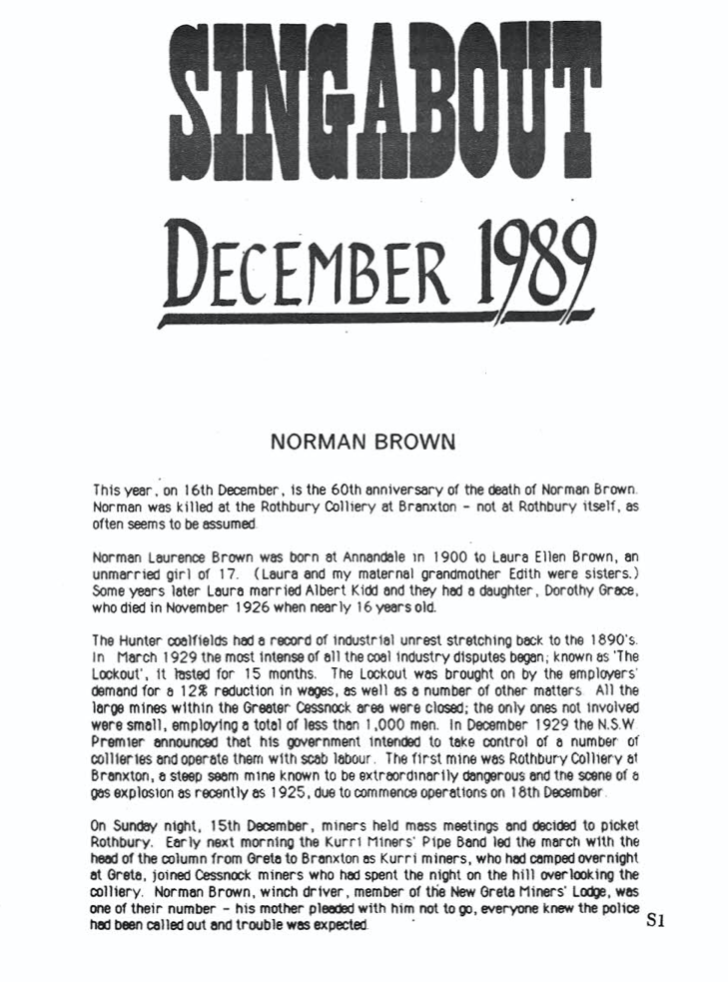
From the Archives - Norman Brown, by Jennie Richards. Mulga Wire no.76, December 1989

Mulga Wire no.76, December 1989, pp. S1-S4


A Sad Day on the Coalfields.   Slowly with expression.
Words and music  by Roger Grant, Weston, 6/12/30. 
 Roger was a miner in Weston, 20 miles from Rothbury. 
Lyrics, history & audio
 here 

Ballad of Norman Brown by Dorothy Hewett


.
.
.


~~~~~~~~~~~~~~~~~
From Jennie, August 2020

I've just been reading December 1957 Singabout on the blog & hadn't realised that Dorothy Hewitt's poem about Norman Brown was published so early. Have I told you that Norman Brown was my first cousin once removed? Norman's mother Laura, and my maternal grandmother Edith, were sisters. My mother was only 5 when Norman died; my middle name is Grace after Norman's sister Dorothy Grace Kidd (Laura had Norman when she was 17 and unmarried, she later married Albert Kidd and they had Dorothy Grace) who died at 15.

Mum often spoke of both Norman and Gracie - Dorothy Grace seems to have been called Gracie - I think she was close to Auntie Laura. Poor Laura; in her mid 40s she had lost both of her children young and in sad circumstances. I don't remember Laura, she died when I had just turned one.

There's always a family story behind every tragedy, even one that makes the history books.

First time I realised that was in December 1979; I had just put Doug to bed and caught the tail end of a story on ABC news about miners marching to a memorial to commemorate the 50th anniversary of Norman's death.  I rang them and they read out the full story to me, and that's when it hit me - that this was bigger than just a story which had come down in my family.

The first time Kevin and I went to a BMC night ... would have been in about the mid 80s ... Margaret Walters sang that song, I had never known of it. I introduced myself and told of my connection, which they found interesting.

It's an odd feeling - difficult to describe - that something in your family you have grown up knowing about is considered "history", in fact a very important part of labour history, as it's the only time police have fired on demonstrating workers in Australia. Before we left Sydney we saw an exhibition called "Policing the Depression" at the Police and Justice Museum near Circular Quay; part of it was devoted to the industrial trouble on the Hunter Valley coalfields in the 1920s, including Norman's death.


Jennie also sings Graham Seal's The country knows the rest another well known song about Rothbury and Norman Brown. Graham's soundcloud page 

Further information 

Resources – Norman Brown & the Rothbury Riot (Terry Callaghan History and Genealogy) - includes coroner's report 


~~~~~~~~~~~~~~~~~~~~~~~~~~~~~~


Tuesday, 18 August 2020

Singabout - Journal of Australian Folksong, Volume 2(3), December 1957

Click images for larger size.


1.   Singabout, Volume 2(3), December 1957 - cover - Herb Gimbert

2.   Singabout, Volume 2(3), December 1957 - EDITORIAL - New magazine from Canada ... SING ALONG.  Goondiwindi Song - One of the petty annoyances encountered in the publishing of folk songs is that no sooner has a song been printed that new versions turn up all over the pale. While our last issue was at press the editor collected an additional verse .. Now Russel Ward at the University of New England contributes a variant fragment ...  CONTENTS

3.   Singabout, Volume 2(3), December 1957 - The Shores of Botany Bay. Sung to the editor by "Duke" Tritton, of Concord, N.S.W., "Duke" has heard another song to the same tune called The Shores of Americay.

4.   Singabout, Volume 2(3), December 1957 - Banana-Benders Ballad Night. Ballad night at the Manifold's Wynnum North (Q) has become an annual event for all the bush-musicians in the Brisbane area.  ... Queensland University Bush Music Club ... collected their own WILD COLONIAL BOY.  ... Blackburn sisters won the under-17 trophy with CONVICT MAID. ... Practically every entry deserves praise.  The very youngest competitors were the Wynnum North Greenhide & Stringybark Orchestra who hand-made their own instruments, ages range from 6 to 12.  ... Morton Bay Girls High School electrified us with a lovely ANDY'S GONE WITH CATTLE, two-part with zither. ... Flu cut down the adult teams ...  One remembers the unaffected and authentic recitations of Paterson by Brisbane Realist Writers: the vivid hornpipes and JACK POWER by Malouf's Mob; the virtuoso percussion of the Banana-Benders: the De Vidas' family's world-wide repertoire done with great dramatic force: the heroic remnant of the Morton Bay Bushwhackers in THE OVERLANDERS  and TEN THOUSAND MILES AWAY: the lovely tone-colour of the Bandicoots mandolins and guitars: and the balanced part-singing of Peter Hickinbotham's Brisbane Singers.  ... nearly very team had something new for us: one WILD ROVER, two COLONIAL BOYS, and THE CONVICT MAID were "first-evers"  ... Not all bands now consider the lagerphone essential; spoons and currajong clappers, kerosene-tin drums and castanets added percussive variety to the programme.  ...  But youth was the real feature of the night! Eighteen competitors were under 17 years of age; and four others eliminated by flu, were just as young. The bearded figure with the concertina no longer typifies bush music in my mind's eye: he is balanced by an enchanting small girl blowing terrific bass G's from an empty bottle.  ...  The evening was not without it's lessons. The A.D.D. reminded us we need to dance as wall as play ...


5.   Singabout, Volume 2(3), December 1957 - A GUM TREE CANOE - this unusual song was sent to SINGABOUT by Frank Nickel, leader of the Melbourne Billabong Band. Frank writes "It was sent to us by Mrs J. Wilson who we met at one of the functions where our band has performed. The song was remembered by members of her family, who learned it from an old chap, Freddie Bolton, en employee on their farm at St. Arnaud about 30 years ago. He was in the habit of sitting at the door of his hut of an evening, playing his fiddle and singing many of the bush songs"

6.  Singabout, Volume 2(3), December 1957 - WALLABY LIZ  words and music by Stan Wakefield, who writes Wallaby Liz may of may not have been a real person long ago, but thirty-odd years back in the tall timber country of South Gippsland, which is noted for it's axemen rather than horsemen, she was a local legend and the stories of her wild gallops through the bush were numerous. But legend was unkind to her and gave her a much less happy end than I have given her in my song.

7.  Singabout, Volume 2(3), December 1957 - WALLABY LIZ  (cont). With lute and guitar. Barbara Lisyak (above) who sings folk songs from many countries, has made several TV appearances and has recently been recorded by Wattle. "Fran" Shaw accompanies her singing with the lute, a beautiful instrument that is rarely heard these days. "Fran" is an enthusiastic Bush Music Club member and performs with the Club's Concert Party. Our Cover Photo - Herb Gimbert , of Erskineville, is a regular attendant at out Club Workshop nights. He plays both button accordion nd tin whistle, and often provides the music for a reel or a varsovienna.

8.   Singabout, Volume 2(3), December 1957 - NEW BOOKS - Songs from the Bush, collected & edited by John Meredith and others, and arranged by Alfred Hill. (Allen & Co Pty, 5/-) A composer with an international reputation has collaborated in the preparation of SONGS FROM THE BUSH. Australian composers of what is popularly known a"serious music" have, almost without exception, wholly ignored or been unaware of Australian folk songs. It is to be hoped that Alfred Hill's interest will boost the work of that small body of Australians who in recent years have assiduously been collecting and endeavouring to popularise their native songs ...

9.   Singabout, Volume 2(3), December 1957 - Songs from the Bush, (cont)  ... All in all, Songs from the Bush, is great fun to sing and play, and a valuable contribution to Australian culture. It is to be hoped that the book will prove popular enough to encourage the same collaborators, and others to present more Australian folk songs in this way.  Peter Hickinbotham   Reviewed in Brief - THE AUSTRALIAN ACCORDIONIST. Notes and news about the accordion and harmonica, available from Kurt Jacobs & Co, Sydney. SING OUT - Mainly American folk songs, topicals and features, available from Sing Our Inc, New York. JOURNAL OF THE ENGLISH FOLK DANCE AND SONG SOCIETY. The wealth of British folk lore contained in this annual makes it a must for all folk singers nd students. Now in it's 58th year ...  available from Cecil Sharp House, London. ENGLISH DANCE AND SONG. The magazine of the the above society is published every two months. Other publications received - THE QUEENSLAND BUSH TELEGRAPH (Q'ld Bush Music Club), SING (The London Youth Choir), SINGALONG  (Ray Hull, Vancouver)

10.  Singabout, Volume 2(3), December 1957 - How to RATTLE YOUR BONES. Everyone who rattles the bones has his individual technique and his on special method of preparing the instruments. Dud Mills of Mudgee who performs with the Holland boys, belongs to the "hardwood"school and describes here his techniques:  ...
Les Ross of Woy Woy who sometimes accompanies "The Four Sisters" ensemble, use the real bullock ribs.  Here is Mr. Ross' method of preparing the bones for playing ...

11.   Singabout, Volume 2(3), December 1957 - OLD T.I. Here is a song that comes from Thursday Island, at the tip of Cape York Peninsular. It is fairly well known in Northern Queensland, but the Thursday Islanders regard it as their own song. Alan Scott recorded it from the singing of Mrs Peg Pemberthy of Brisbane, who had learned the song from T.I. seamen in Cairns.

12.   Singabout, Volume 2(3), December 1957 - BALLAD OF NORMAN BROWN. In February 1929 ten thousand miners received dismissal notices at 27 collieries controlled by the Norther Colliery Owners' Association ... In November of the same year six thousand miners marched at Rothbury in protest against the use of scab labour in the pits. The police provoked a riot, used firearms and killed a young miner named Norman Brown ... A song composed by R. Grant called A SAD DAY ON THE COALFIELDS describes the funeral of Norman Brown and was sung for years afterward ...   "He was not engaged at the time of his death in any breach of the law"  Now after 28 years Rothbury is remembered again in this ballad by a young Sydney poet, Dorothy Hewett. The tune is an adaption of a traditional Scottish song. THE COLLIER LAD.

13.   Singabout, Volume 2(3), December 1957 - BALLAD OF NORMAN BROWN - words Dorothy Hewett, Tune: Traditional, The Collier Laddie

14.   Singabout, Volume 2(3), December 1957 - OUT ON THE CONDAMINE - This song is descended from a long line of British ballads with the same theme.

15.   Singabout, Volume 2(3), December 1957 - THE STATION HAND'S REPLY - This comment on the "town verses country" argument was written by 24-year old Trevor Rose, a station hand employed on the Inglewood Estate, near Merrywinebone, NSW. The editors suggest it be sung to the tune PADDY FAGAN, printed here.

16.   Singabout, Volume 2(3), December 1957 - Friday night is Workshop Night at the Bush Music Club. Every Friday night at 7.30, in The Esperanto Studies, Ennis Road Milsons Point - right under the station on the Kirribilli side.  Three hours of traditional songs and dances - visitors welcome.

SINGABOUT.  Issued quarterly. Editor John Meredith. Asst editor Alan Scott, Art editor Gil Small, Orders & Subscriptions Gay Scott.  Published by Alan Scott.


Saturday, 1 August 2020

From the Archives - Weevils in the Flour, October 2012. A preliminary history of a song; Mark Gregory

Click images for larger size.

reproduced with Mark's permission

1. Weevils in the Flour, words:Dorothy Hewett, music: Mike Leyden

2. Dorothy Hewett based the song on her friend Vera Duncan's memories of growing up on the river during the depression.
From an Island in a River - Remembering Vera Duncan, 1926-2021. by Rod Noble 


3. First recording of the song was by Gary Shearston in 1965

4.  Gary singing Weevils in the Flour 

5.

6. In 1963 Vera contributed an old recitation to Singabout
7. Singing Back the River - A Chapbook © Vera Duncan, Marilla North & Yarnspinners Press Collective, 2019.

8. Mary Gilmore National Literary Competition, 1957 where Dorothy Hewett & Vera Deacon won prizes for Short Stories, & 2 BMC members Dorothy Hewett & Kenna Rushbrook were mentioned for submitting "poems with promise." Mrs Vera Deacon is listed in our 1958-1966 Mailing List as the contact for the Realist Writers. (Kenna & her future husband Tom Durst were founder members of the Bush Music Club) 
~~~~~~~~~~~~~~~~~~~~~~~~~~~~~~~~~~~~~~~
Album notes by Edgar Waters to Gary Shearston's recording of Weevils in the Flour, 1965

WEEVILS IN THE FLOUR
Some of the older generations of Australians complain that young Australians who have grown up in the affluent post-war years do not appreciate the hardships which their elders endured during the depression. Probably they do not. But this song - the words are by Dorothy Hewett, the melody by Mike Leyden - seems to have made a considerable impression on many young Australians in the folk-song audience.
.
.
.

~~

Sunday, 28 February 2016

Extracts from Singabout - the early songwriters - Dorothy Hewett (1923-2002) & Merv Lilley (1919-2016 )

Click on pictures for full-screen image

The Bush Music Club published many new songs & poems in Singabout, Journal of Australian Folk Song between 1956 and 1967. This series lists the works of these songwriters and poets and provides biographical information where possible.

 Interview with Merv Lilley by Alex & Annette Hood, held in the National Library
Bookmark: https://catalogue.nla.gov.au/catalog/3308955
Merv Lilley born Rockhampton, Qld. talks about his family background and ancestry; the Murphy Murders in Gatton, Qld.; reading the book "Gatton Man"; the book "The Channels"; his father and his relationship with his two sons; his father teaching his sons to fight; living on the farm while his father was away working as a commercial traveller; suffering a "rupture" from heavy lifting, his work and relatives; Charles "Bluey" Bostock; dairy work in Mackay; the possum season, skinning of possums; the shooting of koalas; working on Cleve Station, out from Marlborough; an operation for his "rupture"; joining the army following an argument with his father; his mother and her relationship with father; his writing beginnings, a teacher's encouragement for writing and recitation; leaving school and his first jobs; the reality of life in the bush; his interest in the Communist Party; smoking.

Lilley speaks about working for Brett's sawmills for 12 months (1944) after leaving the Army; training for boxing at "Snowy Smith's" Gymnasium; a bike accident; George McKinnon; Army life and being on Goods Island when John Gorton was shot down; the army refusing to recognise the men of island service; a post-war battle for recognition; the bombing on Horne Island; a court marshal; his decision to leave the army; being unable to box due to injury, his regrets about this; talks of fighting techniques; his fitness; the last fight; "Bronco Johnson" and his troupe; Cassius Clay; Tom O'Flynn; Alex Hood talks about Merv's songs, published by the Bush Music Club; a misunderstanding with John Meredith; how he met Dorothy Hewitt; meeting Zoe O'Leary from "Realist Writers"; advice given about how to write; meeting Dorothy in Melbourne when she wrote "Bobbin Up"; being regarded as a "Revisionist"; the Australasian Book Society; being asked by Dorothy to go to Perth to learn to write poetry; communicating through John Meredith.


Biography
  • Merv Lilley is a well known writer of prose and verse. His connections with progressive left wing artists and writers, along with his years of experience working around the country as a farm labourer, cane cutter, station hand, seaman and professional boxer have given his writings an authentic and penetrating quality, which show him to be a true chronicler of his life and times. His working partnership with Dorothy Hewett forged a common concern and love for the Australia of the working people. He has been very active in writers' organisations and many of his poems have been set to music and are part of many singers' repertoires.

    =========================================

VIDEOS - A Lyrical Afternoon at Varuna, The Writers' House Katoomba, In celebration of the life and work of Norman Talbot, Dorothy Hewett and Merv Lilley was held on the 15th September 2012.

A Celebration of the Life and Work of Dorothy Hewett (1923-2002)
A Celebration of the Life and Work of Merv Lilley by his daughter
 
==================================
Wikipedia article on Dorothy Hewett 


Dorothy Hewett with seashell (photo courtesy of Rozanna Lilley) 
 An unbridled rage to live Dorothy Hewett: poet, playwright, novelist and bohemian, 1923 - 2002. Obit - Sydney Morning Herald
===================================
Rozanna Lilley's album of family photos on Flickr

Merv Lilley & Dorothy Hewett (photo courtesy of Rozanna Lilley)
Biography of Merv Lilley on The Vulgar Press website


Merv Lilley, age 96 years (photo courtesy of Rozanna Lilley)

Obit by Patrick Cornish, The West Australian, 28th September 2016

Eulogy by Rozanna Lilley

*************************************

Dorothy Hewett

Ballad of Norman Brown by Dorothy Hewett  (tune - the Collier Laddie), Singabout 2(3), December 1957


From Jennie Richards, former BMC member, August 2020

I've just been reading December 1957 Singabout on the blog & hadn't realised that Dorothy Hewitt's poem about Norman Brown was published so early. Have I told you that Norman Brown was my first cousin once removed? Norman's mother Laura, and my maternal grandmother Edith, were sisters. My mother was only 5 when Norman died; my middle name is Grace after Norman's sister Dorothy Grace Kidd (Laura had Norman when she was 17 and unmarried, she later married Albert Kidd and they had Dorothy Grace) who died at 15.

Mum often spoke of both Norman and Gracie - Dorothy Grace seems to have been called Gracie - I think she was close to Auntie Laura. Poor Laura; in her mid 40s she had lost both of her children young and in sad circumstances. I don't remember Laura, she died when I had just turned one.

There's always a family story behind every tragedy, even one that makes the history books.

First time I realised that was in December 1979; I had just put Doug to bed and caught the tail end of a story on ABC news about miners marching to a memorial to commemorate the 50th anniversary of Norman's death. I rang them and they read out the full story to me, and that's when it hit me - that this was bigger than just a story which had come down in my family.

The first time Kevin and I went to a BMC night ... would have been in about the mid 80s ... Margaret Walters sang that song, I had never known of it. I introduced myself and told of my connection, which they found interesting.

It's an odd feeling - difficult to describe - that something in your family you have grown up knowing about is considered "history", in fact a very important part of labour history, as it's the only time police have fired on demonstrating workers in Australia. Before we left Sydney we saw an exhibition called "Policing the Depression" at the Police and Justice Museum near Circular Quay; part of it was devoted to the industrial trouble on the Hunter Valley coalfields in the 1920s, including Norman's death.


Jennie also sings Graham Seal's The country knows the rest, another song about Norman Brown.

===============


Merv Lilley  (8 songs)

Singabout 1(1) Summer 1956, p.7


Cane Killed Abel
by Merv Lilley    Music: Chris Kempster, Singabout 1(1)

We Gave A Fair Go by Merv Lilley, another version of his popular Ho - Give a Go. Singabout 1(1)


The Bushwhackers
singing Ho Give A Fair Go at the first Singabout night, 1955

Left to right - Harry Kay (mouth organ), Brian Loughlin (lagerphone), Alec Hood, Jack Barrie, with John Meredith (accordion) behind Alec. 
Singabout 1(1), p.5, published January 1956.

The first Singabout night was held sometime between October & early December 1955 on a very rainy night (source - December 1955 Newsletter)

Sat 26th November according to Jamie Carlin's 1955 diary.  (unpublished, Sept 2024)

The Farmer up a Tree
by Merv Lilley (tune Jimmy Riddle) Singabout 1(1)

Bound for Darling Harbour
by Merv Lilley, Singabout 1(1)

Eight Bells by Merv Lilly   (tune - Ring the Bell, watchman), Singabout 1(2), Autumn 1956

The Rona's Last Trip by Merv Lilley   Music: John Arcot, Singabout 1(4), Spring 1956

Definitely Barred by Merv Lilley, Singabout 3(1),  Summer 1958

Farewell Snowy Lamb - words, Merv Lilley, (tune - The Dying Stockman), Singabout 3(2), Autumn 1959

~~~~~~~~~~~~~~~~~
Mulga Wire, no. 153, Singabout insert, 4 pages, October 2002.


****************************************