Tuesday, 20 November 2012

Bush Music Club Newsletter Vol.1, no.1, October 1955

Click images for larger size.
Bob Bolton has been searching through our Archives & gathering items of interest. It is amazing what our founders & founding members accomplished in the first 12 months.

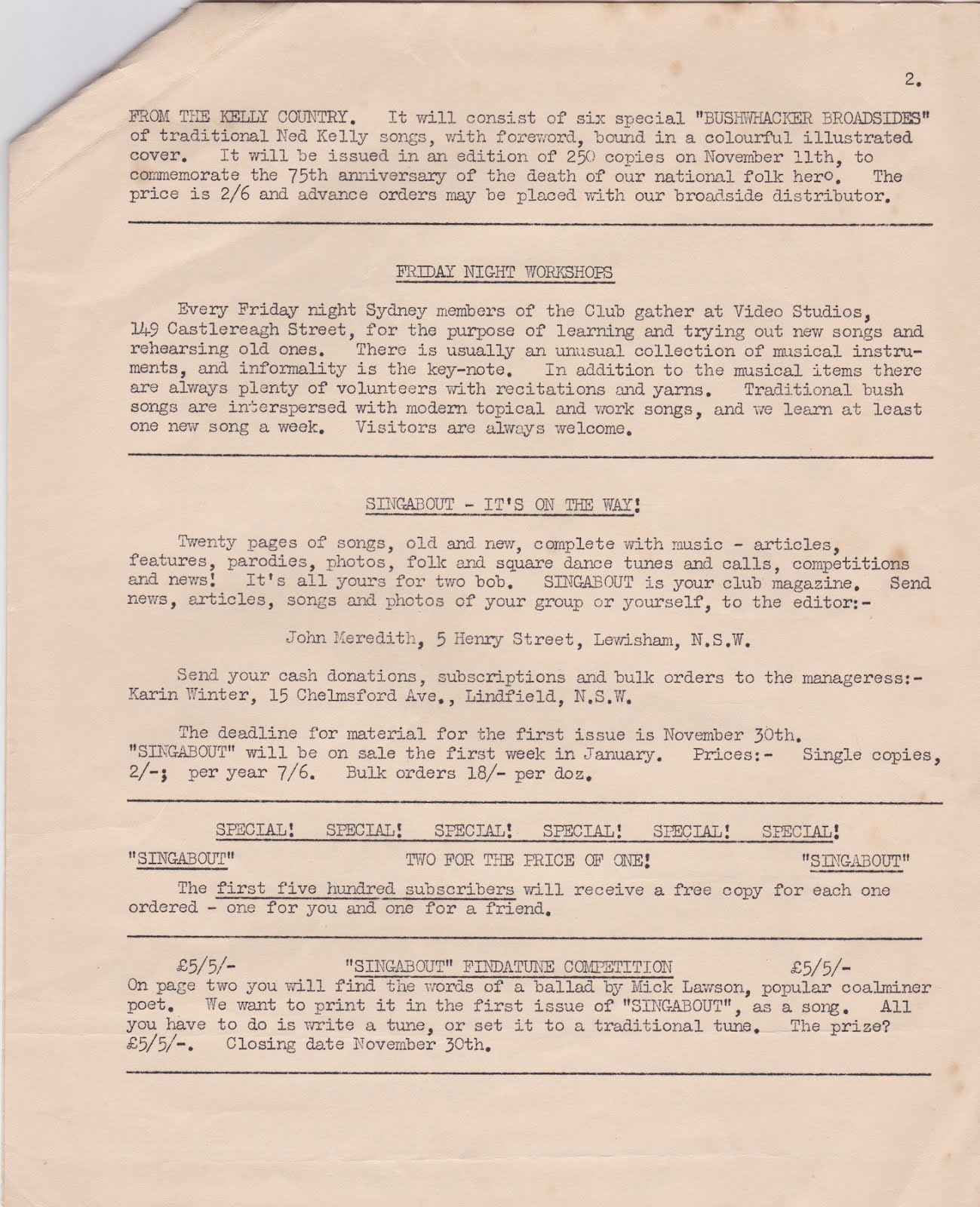


The newsletter was not illustrated but pictures of relevant items have been added.


.........................................................................................


BUSH MUSIC CLUB NEWSLETTER

Vol. 1. No, 1 ___________ October, 1955.__
The Bush Music Club is one year old this month. in that time we have helped set up several singing groups and folk music ensembles; we have published a dozen “BUSHWHACKER BROADSIDES”, and. our affiliated groups have performed at many functions. To celebrate our birthday we have decided to bring out two new regular publications. “SINGABOUT” will be our new club magazine. It will appear quarterly, beginning in January. In between issues of “SINGABOUT”, our “BUSH MUSIC CLUB NEWSLETTER” will keep you informed of all our activities.
____________________________________________________________________________
“BUSHWHACKER BROADSIDES”
Our series of illustrated songsheets with music has proved so popular with our audiences and subscribers, that we have difficulty in keeping up supplies.
Those published so far are:
1) The Old Man. Kangaroo; (2) The Old Bark Hut; (3) Jim Jones at Botany Bay;
4) The Rabbiter's Song; (5) Ho, Give a Fair Go; (6) Hungry Jim the Miner;
7) Wally the Weatherman; (8) The Black Velvet Band; (9) The Bold Kelly Gang;
10) Bound for Darling Harbour; (11) Farewell to Greta.
Numbers 1, 4. and 5 are out of print. Numbers 2, 3, 6 and 7 are in their second edition. Others in preparation are:- Australia on the Wallaby, The Bullockies Ball, Cane Killed Abel, Ye Sons of Australia, The Kellys, Byrne and Hart, Stringybark Creek, Kelly was their Captain etc.. “BUSHWHACKER BROADSIDES” cost 3d. each, or 2/6 a dozen, They are obtainable from Alex Hood, 19 Hughes Street, Potts Point, N.S.W,


__________________________________________________________________________
NEW SINGING GROUPS
More and more people are finding that it is more fun to sing and play as a team than to give solo items, “Bushwhacker” type groups are flourishing in Brisbane, Melbourne and Newcastle. The Lithgow ‘WOMBATS”, with their imaginative style and live wombat mascot, are achieving fame on the western coalfields, and a new group has just started on the south coast. In Sydney, the “ROUSEABOUTS” beginning to steal the show from the “BUSHWHACKERS”. For those who like choral singing, the PEOPLES’ CHOIR, led by Paul Wi1liams and the WEST SYDNEY SINGERS, led by Ken Hansen are providing a good field to work in. Some of the groups have already affiliated with the BUSH MUSIC CLUB. Has yours? The Affi1iation fee is 10/- per year per 50 members. Send your application to the Club
Secretary: Alan Scott, 57 Crown Street, Woolloomooloo, N.S.W.
____________________________________________________________________________
SONGS FROM THE KELLY COUNTRY
Our first song book was such a success that it sold out in a few weeks.
We have decided to produce them regularly, and the next one will be six “SONGS FROM THE KELLY COUNTRY. It will consist of six special “BUSHWHACKER BROADSIDES” of traditional Ned Kelly songs, with foreword, bound in a colourful illustrated cover. It will be issued. in an edition of 250 copies on November 11th, to commemorate the 75th anniversary of the death of our national folk hero. The price is 2/6 and advance orders may be placed with our broadside distributor.


____________________________________________________________________________
FRIDAY NIGHT WORKSHOPS
Every Friday night Sydney members of the Club gather at Video Studios, 149 Castlereagh Street, for the purpose of learning and trying out new songs and rehearsing old ones. There is usually an unusual collection of musical instruments, and informality is the key-note. In addition to the musical items there are always plenty of volunteers with recitations and yarns, Traditional bush songs are interspersed with modern topical and work songs, and we learn at least one new song a week, Visitors are always welcome.

____________________________________________________________________________
SINGABOUT - IT’S ON THE WAY!
Twenty pages of songs, old and new, complete with music - articles, features, parodies, photos, folk and square dance tunes and calls, competitions and news! It’s all yours for two bob • SINGABOUT is your club magazine, Send news, articles, songs and photos of your group or yourself, to the editor:-
John Meredith, 5 Henry Street, Lewisham, N.S.W.

Send your cash donations, subscriptions and bulk orders to the manageress:-
Karin Winter, 15 Chelmsford Ave., Lindfield, N.S.W.

The deadline for material for the first issue is November 30th.
“SINGABOUT” will be on sale the first week in January. Prices: - Single copies, 2/-; per year 7/6. Bulk orders 18/- per doz.
____________________________________________________________________________
SPECIAL! SPECIAL! SPECIAL! SPECIAL! SPECIAL! SPECIAL!
“SINGABOUT” TWO FOR THE PRICE OF ONE! “SINGABOUT”
The first five hundred subscribers will receive a free copy for each one ordered - one for you and one for a friend,
____________________________________________________________________________
£5/5/- “SINGABOUT” FINDATUNE COMPETITION £5/5/-
On page two you will find the words of a ballad by Mick Lawson, popular coalminer poet. We want to print it in the first issue of “SINGABOUT”, as a song. All you have to do is write a tune, or set it to a traditional tune. The prize? £5/5/-. Closing date November 30th.
____________________________________________________________________________

“IT’S LOVELY DOWN THE PIT, LAD” - by Mick Lawson,

The miner is a happy lad, he lives a lovely life.
He dearly loves the owners so he never gets in strife.
The miner is a 1ucky lad, he lives a life so free
And now each morning, with his crib, he gets a pot of tea.

Chorus:
So hasten to the pit-head lads, and let’s go down the mine.
For a miner’s life is a lovely life, oh a miner’s life is fine.
So drop us down the pit winder, drop us down below

We’ll pick and drill and shoot and fill then homewards we will go.
It’s lovely down the pit my lad, there’s nowt so much to do
Save drill a hole and shoot the coal and shovel all day through.
And if tha’s feeling tired lad, why don’t get in a rage.
Just think that in a few hours more you’ll ride up in the cage.
So give three cheers for the Coal Board and the men who own the mine.

For a miner’s life is a lovely life, the job is really fine.
He drops down in a lovely cage and when he’s in his bord
He just fills twenty ton or so and rides up like a lord.

Of course, at times, we have a ‘fall’, we don’t care much for that
For several tons of rock or coal will smash you rather flat,
But on the other hand. lad, it’s really only fair
To say we’re safe from hailstones, so we’ve got something there.

It’s lovely down the pit lad, but in spots it’s rather dark,
But if we fall flat on our face we treat that as a lark.
It’s lovely down the pit lad, a really bonzer show.
Oh a miner’s life is a lovely life - why don’t you have a go?

Last Chorus:
So hasten to the pit-head lads, and let’s go down the mine
For a miner’s life is a lovely life, oh a miner’s life is fine.
So drop us down the pit winder, drop us down below
We’ll pick and drill and shoot and fill then homewards we will go.
Then homewards we will go lads - at least we’re hoping so.

Rules.
Melody line only of one verse and chorus, plus last line of last chorus is required. The tune may be original or an arrangement of a non-copyright traditional tunes. The executive of the Bush Music Club shall be the judges and their decision will be final. The winning tune will become the property of the BUSH MUSIC CLUB. There is no entry fee. Fill in this form and enclose it in a sealed envelope, bearing your pen name,
Attach to MS which must only bear the pen name of the entrant.

Send entries to: Editor, “SINGABOUT”, 5 Henry Street, Lewisham, N.S.W.
Name ……………………………… Address ………………………………………………….
Pen Name ………………………………………………………………………………………
I agree to abide by the above rules,
Entrant’s signature ……………………………………………………
CLOSING- DATE: November 30th, 1955.
____________________________________________________________________________

Published for THE BUSH MUSIC CLUB by A. Scott, 57 Crown St., E. Sydney,

************************************************************************************************ ************************************************************************************************

Monday, 5 November 2012

Let’s Hear It For Merro! by Alan Scott, Mulga Wire No. 14 August 1979

Click on pictures for full-screen image


Recently I was trying to write down a tune I remembered and couldn’t decide what time signature it should have. I knew it was in the same time as the tune we played for The Flying Pieman. That dance was called The Flying Scotsman till John Meredith re-named it when he introduced it to the Bush Music Club. I found the tune in the Complete Book of Australian Folklore for the dance Thady You Gander. While searching in that book I found “The Victorian Folk Music Club uses the following combination of tunes: Kelvin Grove; Muckin’ O’ Geordie’s Byre; Bonnie, Bonnie Banks Of Loch Lomond.”

And I thought, “Yes, the V.F.M.C. may use that combination of tunes but it was John Meredith who worked out that they would fit the dance, with the option of repeating the last line of Loch Lomond if the set was a bit slow.”

I got to thinking, then, of all the things the Folk movement in Australia owes to Merro. In the early Bushwhacker Band days when our audiences asked, “Where can we learn these songs?” it was John who proposed we form the Bush Music Club and became our first M.C. The Bushwhackers were as busy then as any Bush Band these days, with three or four performances a week, rehearsals and radio broadcasts and John was the driving force in that group. He was busy in the Folklore Society and in library research at the same time as he continued searching for and recording folksingers and musicians.

 
You might think, on reading his Folksongs of Australia, that he was lucky to find so many valuable informants but it required dedication, perseverance and sheer physical endurance. His tape recorder, unlike today’s transistorised models, weighed about thirty pounds and he relied mostly on public transport. I recall going with him to the flatlands of Maroubra one Saturday afternoon when we had a quarter mile hike from the tram to the singer’s home, I carried the recorder The cool sea breeze blew sand in our faces and my arms were stretched longer by the time we got there. After a couple of hours we went back to the tram and that night performed with the rest of the Bushwhackers over on the other side of Sydney.

 
Folksongs of Australia is John’s outstanding achievement but he did things many people are unaware of, ie finding the music given in title only for Plains of Emu, Where’s Your Licence and Ned Kelly’s Farewell To Greta. He altered the words in Banjo Patterson’s Bushman’s Song from: “Eight or ten dashed Chinamen” to the more acceptable “Eight or ten non-union men” and when he set Henry Lawson’s A Word to Texas Jack to a traditional tune, he changed Lawson’s words too. When he recorded The Bullockies’ Ball it was short of two lines so he wrote a couple that fit so well that I, who know they were added, have difficulty distinguishing them. He searched out the music that was given as the tune for Jim Jones At Botany Bay and, I suspect, added two lines to complete an unfinished verse.


The idea of Singabout magazine was his and he was its first editor with all the work that such a venture entailed. He conceived the Ned Kelly seventy-fifth anniversary song book and supplied traditional tunes for those songs that lacked them. 

 
When he had the idea for the Lawson Songbook he contacted the composers of the music used, arranged for Dame Mary Gilmore to write the introduction and asked Clem Millward to illustrate it.

 
He by no means held aloof from the mundane work that had to be done in the Club. I remember the working bees at his home making hundreds of crepe paper waratahs used to decorate the B.M.C. float in the Waratah Festival procession. Merro went out to the circus to hire an elephant for us and would have done but it was too late to get a council permit. So we used a horse drawn dray instead and gave the waratahs away to the crowds at the end of the procession.

This immersion in Australiana and Bush Music did not destroy his perspective. He was and remains, an enthusiastic expert, not a fanatic. So let’s hear it for Merro, Australian folk music probably owes more to him than to any other individual.

Alan Scott.

Mulga Wire No. 14 August 1979

---------------------------------


Bob Bolton's comments after scanning this article

* Hmm…I had a good look at my reference copy of Bill Scott’s “Complete Book of Australian Folk Lore” (Ure Smith, Sydney 1976) … and I can’t find that quote at all. I don’t think there was any ‘second edition’ … so Alan may have been looking at some other comprehensive ( … but Victorian-biased … ) book of Australian Folklore

I also checked various versions of the Ron Edwards’ Big Book of Australian Folk Song … and I did find this on page 765 of my on-line (10 volumes) version. The reference to the renaming of “The Flying Scotsman” to “The Flying Pieman” – by Noreen Grunseit is what I have always believed … but a smart idea is a smart idea … and lots of people get credited with primacy of the same idea … depending upon ‘by whom’ and ‘whereabouts?’

FLYING PIEMAN, THE
see also THADY YOU GANDER
(Tune ; The Flying Dutchman)
1. ‘Twas the close of a heavy drinking bout on port and sherry cape.
2. (Dance tune)
1. Noted by Warren Fahey in The Colonial Magazine 1869, the tune being given as The Flying Dutchman.
2. Collected and arranged by John Meredith from Herb Gimbert, Sydney, no date given. 
*Folk Songs of Australia Vol. 1, page 157 1967; reprinted *Australian Tradition 30/14 Dec 1972 with title THADY YOU GANDER or THE IRISH TROT; *Australian Tradition 34 June 1974, notes on p.29, tune on p.52.

In Tradition No. 34, Shirley Andrews explains:
“One member of the Bush Music Club, Noreen Grunseit, adapted a Scottish dance called The Flying Scotsman for dancing by other club members. They altered the name to ‘The Flying Pieman’ to give it an Australian name as this was the name of an eccentric character in early Sydney. The tune used is an untitled Irish jig tune collected from Herb Gimbert by John Meredith”.

*Take Your Partners 56 1976; *Bush Dance 20-21 1984; *Collector’s Choice Vol.2 49 1987.
It will be seen that versions 1 and 2 have nothing in common, the title FLYING PIEMAN in version 2 being a modern addition, the title being given to an old tune.


*******************************************

Thursday, 18 October 2012

In The Beginning … The formation and early history of the Bush Music Club, by John Meredith

Click on pictures for full-screen image

note - date appears to be a typo/lapse of memory as other sources give 1952 for the formation of the Heathcote Bushwhackers - index to Keith McKenry's biography of John Meredith which was created using John Meredith's archives in the National Library, Chris Kempster's recollections, Ballad of the Heathcote Bushwhackers,
Reunion of the surviving Bushwhackers - 50th Anniversary Reunion of The Bushwhackers, National Folk Festival 2002

Jack's surname was Barrie, but both surnames are used in early sources.

It all started with the formation of The Heathcote Bushwhackers. In June 1953 a literary and musical evening held a Jack Barry’s house at Heathcote was to have an “Australian Night” - something unique in those days when our own culture appeared in danger of being engulfed in the flood of second-rate canned American music. Jack, Brian Loughlin and I got together with button accordion and two of our recent discoveries; a tea chest bass and a lagerphone.

Brian Loughlin's lagerphone (BMC Archives)

We stuck on false whiskers, dressed rough and gave out with our entire repertoire; Click Go The Shears, Botany Bay and Nine Miles From Gundagai. In spite of my whiskers falling off, or maybe because of them, we were an immediate success - as a comedy act! Chris Kempster joined us after that performance and then Harry Kay.

We were invited to perform our bracket of three numbers at a
Tribune concert organised by the Australian Communist Party, at the Hurstville Rivoli Theatre. We were a sensation! The audience shouted, stamped and clapped for more and wouldn’t shut up. And we didn’t know any more. Eventually we went back and did Botany Bay again and invited them to join in on the choruses.

The idea of a group playing traditional instruments and singing Australian songs, straight and not in choral arrangements, was novel and soon we could not cope with the engagements that came rolling in. The following year we supplied the songs and music for four or five historical radio features written for the ABC by Nancy Keesing. We were joined by Alan Scott, Cec Grivas and later by Alec Hood. One day Brian Loughlin told me that someone had suggested that we form some sort of a club and after many bright and not so bright ideas for a name we fixed on The Bush Music Club.

Recently, while going through an old scrapbook, I came across the
programme for what was probably Sydney’s first Folk Music Concert. Arranged by Lilli Williams it was presented at History House, then in Young St., on Wednesday 24th November 1954, by Leonard Theile and Patricia Martin...and The Bushwhackers Band. The first item after interval was How Many Miles To Gundagai?, described in the programme as “A bush operetta in one act, based on the controversy around the Dog on the Tuckerbox, using traditional ballads and ballads of the late 19th century, arranged by John Meredith”. 

Leonard Teale (born Thiele) 

We Bushwhackers were quite ambitious in those days and to celebrate the world premiere of the work we published a little eight page booklet. On the last page of this leaflet there appeared the first advertisement for the inaugural meeting of The Bush Music Club: 

 
THE BUSH MUSIC CLUB

We have been approached by many singers and instrumentalists who wished to join the “Bushwhackers”, but we consider that the optimum number for an ensemble such as ours is six. We have been refusing engagements at the rate of three or four a week for several months, not because we want to, but simply for the reasons that we need time to rehearse, we have to work for our living and because we have to get some sleep occasionally.
We don’t like disappointing people so we have decided to form a club, where in return for a nominal membership fee we will give away our secrets. The “Bushwhackers” will help you to learn the accordeon, harmonica, bones, bush bass, lager phone and lots more. We will provide the words and music of our songs and show you how we sing them.
The inaugural meeting and first rehearsal of the BUSH MUSIC CLUB will take place at the Realist Theatrette, 1st Floor, 188 George Street, on Thursday October 14th, at 7 p.m. sharp. Further details may be had from John Meredith, 5 Henry Street, Lewisham, or from any of the “Bushwhackers”. 


If you have read the foregoing closely, you will have observed that the Bush Music Club had been going for about five weeks before the History House Concert took place. This was because the concert had twice been postponed, firstly because of a double booking of the auditorium and secondly because of a radio commitment by Thiele. Our booklet had been prepared in time for the first planned date.

The inaugural meeting was like all other inaugural meetings; we all talked and argued a lot, elected a committee of office bearers, sang a few songs and went home, feeling that we had done a good job. I went along confidently to the second gathering, expecting an overflow house. Three of us turned up! Everyone else sent along excuses of Union meetings, influenza, hay-fever, teething babies etcetera. For that memorable second meeting there was myself, Tom Durst and Kenna Rushbrook.

For a while we made music with accordion, fiddle and mandolin and thought it sounded quite pretty. So did somebody else! On another floor in the Ironworkers Building was the recently formed Trade Union Club - a licenced club, but which in accordance with existing liquor laws closed at 6.00 PM. A drunken woman came looking for grog and blundered into our recital. We ushered her out but she was back again within five minutes. After several repeats of this performance, we locked our door on the inside. It was a glass panelled door and on her return the frustrated and thirsty lady smashed the glass in her desperation, then fled down the stairs, hotly pursued by Tom Durst, who caught and escorted her to the caretaker where reparations were effected

Our numbers soon increased. The Club took over the publication of Bushwhacker Broadsides from the band and then decided to publish its own journal. 


Bushwhacker's Ballad no. 8 (BMC Archives)

Again great discussion for, a name. Finally our secretary, Karen Winter came up with Singabout, inspired by the geographical magazine Walkabout. We decided to hold a concert/folk dance night to raise money for the publication of our magazine and it was called a Singabout Night. Our quarters in the Realist Theatrette became a bit cramped and but still only a small space for dancing...and one big problem. 


We shared use of the studio with the June Dally-Watkins Modelling Agency and Academy. They had an evening class which was supposed to end about fifteen minutes before we arrived. But rarely did. The crisis came one night when the Dally-Watkins lady organised her end-of-year graduation parade on our club night without consulting anyone. After a heated argument as to who was going to have occupancy that night, we hit on a compromise. The girls would model and while they were having their dozen or so changes we would perform, entertaining the models’ parents and friends with brackets of numbers lasting for 15 or 20 minutes.

It went off well, for we were entertained by all the young lovelies pussy-footing down the catwalk modelling swimwear, then sports gear, followed by formals, cocktail gowns etc. and finally, in a crash-hot finale; formal evening gowns. This is where we nearly wrecked the show. I’ve forgotten her name, but I can still remember the beautiful girl who made her stunning entrance, to the Dally-Watkins running commentary. The dress was black, backless and strapless; one of those creations that defy the laws of gravity. Dally-Watkins was just commenting that this was not the dress for every girl, that you must have the necessary physical attributes to support the thing...rhubarb, rhubarb..., when Jack Barry arrived, late as usual. He’d come straight from work, in his khaki overalls, with sports coats over the top, tea chest bass on shoulder. He walked in the door just as the mannequin had completed her walk and was doing her twirly bit, and just stood there, his jaw dropped and his eyes popping out like a lobster’s. Loughlin let out a guffaw and we followed suit. In a minute the whole audience roared with laughter, while the poor girl, who couldn’t see Jack, was visibly shaken and obviously thought something had come undone or fallen down which shouldn’t have. But Dally-Watkins, with her usual aplomb, broke off her resume; escorted Jack to his place and sent her pupil pussy-footing on her victorious, graduating way.

Soon after this episode we gave the Dally-Watkins best and moved to the Seamens’ Hall at the Quay end of Pitt St. Here there was a large floor, where we not only had plenty of room for cavorting about learning old bush dances, but it was large enough for our Singabout Nights as well. But alas, progress - nay, let’s call it development - was hard on our heels and the premises were marked down for demolition.

One of our members belonged to the Esperanto Society - he used to translate our songs into Esperanto - and he arranged for us to rent the Society’s rooms one night a week. These were at Milson’s Point, under the approaches to the Harbour Bridge. We had some wonderful time there and I feel that this and the ensuing period were when the B.M.C. really established itself.

Singabout
Magazine was being published regularly, we had brought out a series of six Ned Kelly Broadsides, then bound them into a book and finally republished it in a smaller format. Here it was that we held our competition for the best setting of a Lawson poem, won by Gay Scott with her still-popular The Roaring Days to the tune of Ten Thousand Miles Away.

Alas, the bogey was still treading at our heels. Trams were abolished and replaced by buses. The old bridge tramlines were taken up and two more lanes made available to the motor car god, erection of toll gates for which meant the demolition of our rented clubrooms.

Our new home was with the Fellowship of Australian Writers, and a cosy home it was too. We had our own locker in the corner, a convenient kitchen and the room with its numerous portraits of Australian writers created a really nice atmosphere. Our close association with the writers at this period brought us into touch with a lot of people we would not otherwise have met. They invited us to perform at their functions and sometimes one of their members would address us. It was at Milsons Point that Duke Tritton first began attending club nights and during the next few years was to become a big influence on our performing styles.


Alan Scott recording Duke Tritton (John Meredith photo - BMC Archives)


Happiness cannot endure; to paraphrase Andrew Marvell

"At our backs we alwaies hear
Time's winged chariot hurrying near"


Yes, the friendly wrecker came knocking on the door, so it was a matter of rolling up our swags once more. This time we followed the Fellowship of Australian Writers when they moved in with the Australasian Book Society. At this time we brought out the
Singabout Songster, consisting of the edited texts of a hundred of our most popular songs. 

During this period, in my opinion at any rate, both the singing and the instrumental music developed to quite a high standard. Under the MC’ship of Chris Woodland the programmes took on a new interest.


Pewter mug given to Chris Woodland when he left Sydney, 1967  (Chris Woodland photo)

I remember the Clarence St. days also as a time when John Dengate developed his wonderful facility for writing topical and, to some people, shockingly irreverent songs. It was also the era when Beer and Cheese nights grew into a sort of wine and banquet night!


John Dengate, Singabout v.6, n.1, 1966   (BMC Archives)

And it was just at this time when, with the publication of Folk Songs of Australia, I decided to devote all my spare time - to the exclusion of Bush Music Club activities - to my research on Frank The Poet and on the Kelly ballads; a step which I have not regretted, but which did deprive me of taking any further part in the activities and development of our club.


72xxxx John Meredith presents (then unpublished) material from his researches of Frank the Poet - Francis McNamara at PACT folk in 1972  (Bob Bolton photo)

Perhaps some younger member can finish off this record by supplying details of the Burwood and Marrickville periods. Perhaps also, some other older members might set aright any errors or lapses of memory which might be obvious in this rough outline of our history.

Mulga Wire No. 17, February 1980, pp.5-10

**************************************************************************

Sunday, 14 October 2012

The Bushwhackers, by Alan Scott.

Click on pictures for full-screen image

A three-part article in Mulga Wire, 1980-81 (citation below)

When Jack Lang published his memoirs at the age of ninety a reviewer pointed out that we had to take his word for what had happened; there was no one else left who had lived through the events. I don’t want to wait that long to describe the beginning of the Bush Music Club, but others may recall things differently. I remember clearly my first involvement with what led to the formation of the Club. Early in 1954 I was in Sydney to attend a Youth Conference and one Saturday night Gay Terry and Lorna Lovell took me to see a musical play called Reedy River. I was enthralled and when it was over I clapped and cheered and howled for more. So did the rest of the audience.


      1.  Reedy River (BMC Archives)

I was already part of the embryo folk song revival. I had sung with a group organised by John Manifold in Brisbane and was friendly with Ron Edwards at the time he and Manifold produced the first of the Bandicoot Ballads. I even knew some of the songs in Reedy River, but I’d never heard them sung in the lively, robust, vigorous and genuine way they were presented that night. After the applause for the last encore, when the audience was persuaded to shuffle out of the stuffy hall, I talked my way backstage on the strength of my acquaintance with two of the cast members; Brian Loughlin and Harry Kay. I knew Harry from Youth Camps in Queensland and I was introduced to Brian outside a milk bar in Brisbane by his brother Kevin.

Kev and I were talking on the footpath when Brian came dancing out humming the Cossack Dance from the Nutcracker Suite and clicking his heels in the air. (This was the same milk bar where Kevin and a mate, being broke, once asked for a glass of water and two straws. It says a lot for the Loughlin personality that they got it!)

Well, Brian showed me the Lagerphone and introduced me to the Bushwhackers, who played and sang in Reedy River and performed separately as a group. 


2.  Brian O'Loughlin's Lagerphone 1956 (BMC Archives)

One of them, John Meredith, invited me to his place to hear the tape recordings he had made. So, to John’s rooms at Lewisham, Gay and I went next day. I took memories of Reedy River and the singers on John’s tapes back to Bundaberg where I was then living; then I went looking for singers and musicians.

“Your Uncle Raleigh used to play the tin whistle,” my mother told me, but Uncle Raleigh was dead. “Your Uncle Will used to play the squeeze box,” Mum said, so I went to see Uncle Will. He got his accordeon off the top of the wardrobe, where the hornets had built mud nests on it, but he had suffered a stroke and couldn’t pump the bellows. Mum could remember her brothers beefing out The Wild Colonial Boy on the front verandah when she was a girl but didn’t recall words or tune; so I had to come to Sydney for the Bush Music.

Arriving in late July, I contacted Merro and became a twenty four year old groupie, turning up wherever the ‘Whackers’ were performing. They soon got tired of looking at me in the audience and asked me to sing on stage with them. Once I went to a party instead of a Bushwhacker engagement and the next time I saw Merro (I remember it was in a pub) he talked very seriously about the dedication of the Band and their self imposed discipline. It looked pretty bad, he said, when someone went off to a party instead of turning up at a performance. At length it penetrated my dim brain that I was part of the Band. A Bushwhacker! And I hadn’t even noticed!


3.  Bushwhackers, photo taken by John Meredith (BMC Archives)
 ~~~~~~~~~~~~~~~~~~~~~~~~~~~~~~~
 (Part Two: Picking up where Alan Scott unexpectedly discovered that he was a dedicated member of his dream group ; The Bushwhackers.)

Not the least part of the dedication John spoke of consisted of performing unpaid.
We claimed only travelling expenses. Fees for engagements went into funds. We dressed in what we thought shearers and bush workers would have worn in the 1890’s and Jack Barrie, who played the tea chest bass, so looked the part that he is one of the few people I know who got applause before he even started singing. Cec Grivas had what I thought was the best voice and Alex Hood played the bones.


4.  Jack Barrie (BMC Archives)

 Harry Kay played the mouth organ, which he liked to call the harmonica, and Chris Kempster played the guitar. Brian Loughlin played the lagerphone and did the spruiking. His introductions were entertaining and sounded spontaneous but were the result of much study of the material. He gave as much thought to playing the lagerphone as Chris did to the guitar and both searched for the most effective accompaniment for each song.


5.  Brian Loughlin, 1957 (BMC Archives)

John Meredith played the accordeon and provided the solid melodic base for the group. He was the Bush Musician personified. We had a campaign to change his presentation. Gradually he changed from staring at one spot until he got to the stage when he could smile and eventually sing as he played!

While I was learning to play the tin whistle (made easier by the fact that I’d played the fife at school) I played the nose flute. If you don’t know what that instrument is you are fortunate. We called it the steel handkerchief and it was hardly the best choice for someone like me with a deviated septum and chronic rhinitis. I was glad when I could lay it away and play whistle full time.

6.  Alan playing nose flute (BMC Archives)

 Such was the cast of characters. We all had some stage experience and developed “bits of business” and interplay of character that became whole hearted in the little play How Many Miles To Gundagai? in which Tom Durst joined us to play the fiddle as the Dog. The group was a synthesis of Australian folk styles. No group like it had existed before but it was authentic in that the instruments and the material were traditional.

We were extremely popular. I have tapes of some of our radio features and they don’t sound much at all but there was no doubt about the enthusiasm of our audiences. They shouted for more.

Being in the Bushwhackers was a good way for a newcomer like me to get to know Sydney. We played for a kindergarten at Chippendale; P. & C. Associations at Caringbah, Terrey Hills and Narrabeen; a Blacksmiths’ Union Smoko at Bondi Junction; at Como to celebrate Lawson’s birthday where pupils from the local school put on a play. We played at Lawson’s statue in the Domain and got our picture on page one of the Sydney Morning Herald. 


7.  Bushwhackers playing at Lawson's Statue, Botanic Gardens Sydney (BMC Archives)

 We played at the Tribune picnic in Royal National Park and the police stopped us playing from the back of a truck in Ashfield because we had no permit. We were publicising a local performance of Reedy River which New Theatre revived in 1955. We were in it of course.
We went to Pagewood for four days of boring inactivity and a couple of hours’ work in the film Three In One.


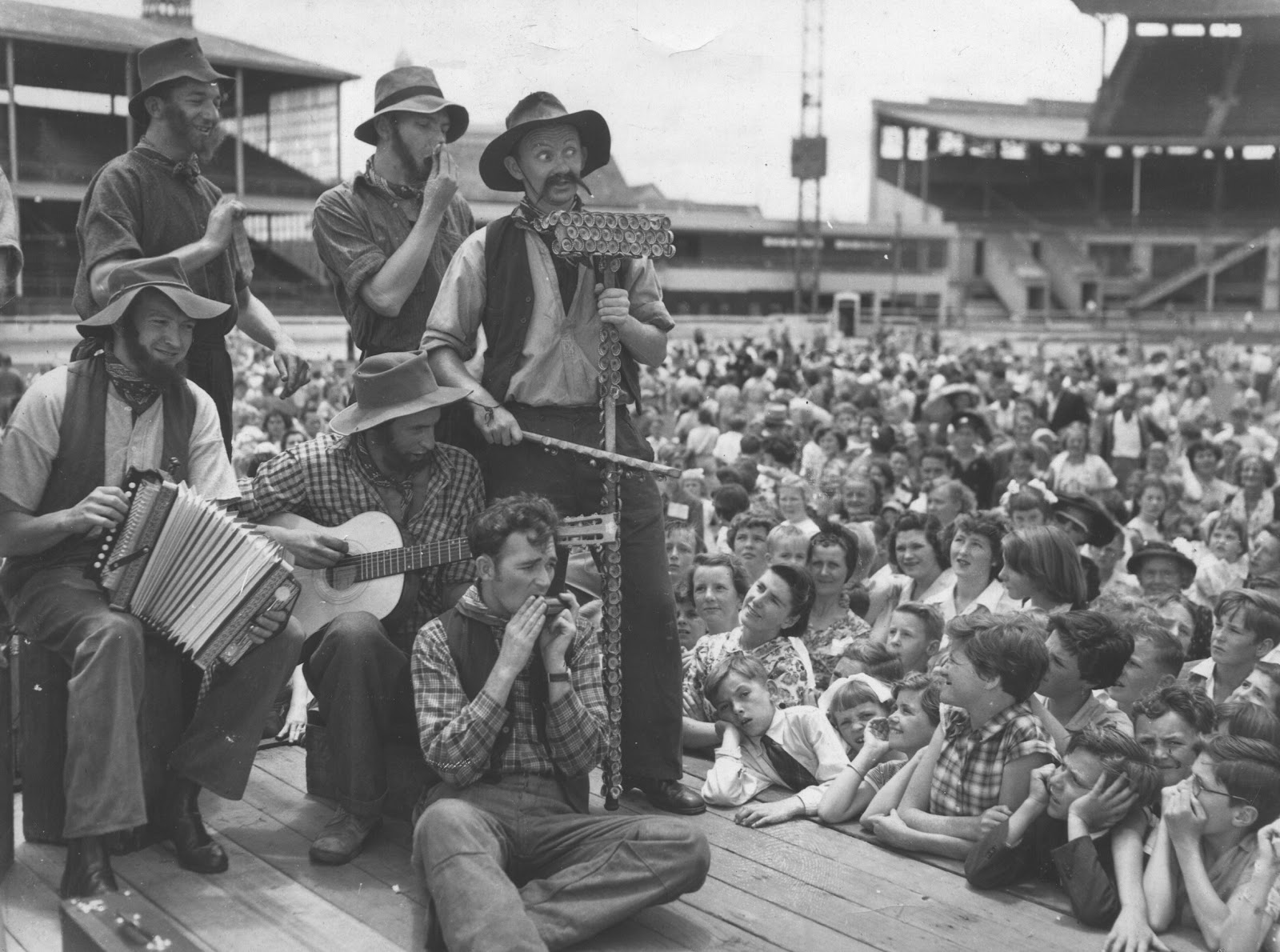
The ‘rushes’ of this showed us capering round on a small bright viewing screen without sound. We looked so good the director decided to use Chris and Brian further in the film. We played in false whiskers to thousands of kids at the Showground for the Smith Family. The kids wanted to tear our beards off and we got our picture in the Herald again. We played at an RSL dance at Dee Why, where I saw my first poker machine.


8.  Bushwhackers at the Showground for The Smith Family (BMC Archives)

 ~~~~~~~~~~~~~~~~~~~~~~~~~~~~~~~

(Part Three: In which Alan Scott finds playing with his dream band is very hard work.)

This is an indication of the workload we carried. I wonder now how we coped! We held down our normal wages jobs, performed all over the place, participated in the Folk-lore Society and the Bush Music Club and were enthusiastic members of the Communist Party with all the political activity involved in that. To those BMC members who might object, a quarter of a century on, to eight young communists helping to found their Club I can only say that’s the way it was. You can’t change history. In retrospect, assisting in the birth of the Club may have been our most important action. 

All of us, bar Brian, were bachelors. Alex, Harry and I got married in the next couple of years. In some ways the girls must have felt they had wed the group, not just a husband. The close association and shared experiences had brought the sort of comradeship enjoyed by a touring football team or the cast of a play.

We went for a night cruise round Sydney Harbour with the Peking Opera Company. I remember Merro telling an interpreter how we collected songs from old people when we went away on country trips. This was translated to their Comrade Manager and we waited for the reply. The interpreter said that the Opera Company, too, did that. For six months every year they visited the countryside collecting material and rehearsing it, then six months performing. Thinking of our forty hour week jobs and our crowded itinerary we could only marvel.

During Wool Week we were employed by David Jones to play for customers in their different stores. The illustration that appears on the BMC letterhead originated then as a newspaper ad. for DJ’s. 

We visited some country towns for different functions. We went down a coal mine at Lithgow and broadcast live over the radio station there where I forgot the words to Drover’s Dream We saw the Hunter River in full flood at Newcastle, put on a concert in Mudgee Town Hall and saw the remains of the Lawson Cottage at Eurunderee.

The Bushwhackers were notably untemperamental but by 1957 our constant association, instead of wearing away our differences, was working to sharpen them. Not all of us realised this or how often Brian’s diplomacy was exercised to smooth things over. A perennial point of difference was the question of singing in harmony. The advocates of this saw it as a way of making our renditions more musically attractive and reviving our (by now) sometimes jaded performances. The majority rejected it but the idea kept coming up with unwelcome persistence. This was a time, too, of turmoil in the Communist Party - there was only one in those days! I remember Brian being asked, “Are you for Kruschev or Stalin?” and his classic reply, “I’m for Marx!”.

The climax came when John resigned. I believe this was not because of personal, ideological or musical problems but because he could not cope with all his other activities and be a Bushwhacker too. So the six remaining members forgathered at Loughlin’s house in Rozelle to thrash things out. The big question was; would we continue as a group or not? The vote was three for and three against. Alex, Harry and Chris continued for a short time as The Three Bushwhackers but soon changed their name to The Rambleers.

So ended the archetype Bush Band. There was no group like it before but there have been many since, singing much the same songs in much the same way. I once boasted to an Irishman that the ‘Whackers had played for every possible function. “Have you ever played at a wake?” he asked. When Brian died most of us turned up to play at his wake. My vague hope that we might one day get together for one final performance died then too.

Part 1, Mulga Wire #22, Dec. 1980, pp. 3 & 4.
Part 2, Mulga Wire #23, Feb. 1981, pp 4 & 5.
Part 3, Mulga Wire #24, Apr. 1981, pp. 3 & 4.

***************************************

Tuesday, 5 June 2012

Memories of early days at the Bush Music Club by R. Dale Dengate


Click on pictures for full-screen image

Talks from BMC's 2012 National Folk Festival Themed Workshop on BMC's First 10 years.


read by Margaret Walters in Dale & John's absence.

As a keen bush walker in the early 1960s, I found the Bush Music Club’s Singabout Songsters in Youth Hostels and met a couple of Club members. They invited me along to their meetings which were held on Tuesday evenings near Wynyard station. The format was similar to Methodist fellowship meetings where you sat around and sang songs. A welcome difference was that at the BMC meetings, we had portraits of well-known Australian writers, such as Henry Lawson and Mary Gilmore, looking down on us as we sang, danced or played.

Bushwhackers singing at Lawson statue in Botanical Gardens, Sydney, c.1956
 (BMC Archives)
Bushwhackers at Dame Mary Gilmore's 90th Birthday in 1955 
(BMC Archives)

There were many keen, nimble dancers, often led by Noreen Grunseit and John Meredith.  Most of the musicians were older men who played concertinas and accordions, except for Frank Maher and Jamie Carlin who were closer to my generation. Frank played the bones, and Jamie played the concertina by ear and didn’t need sheet music, which I found amazing. 
 Concert party, 1957   (BMC archives)
In 1961, I encouraged another young teacher from my school, to accompany me to the Club. He was John Dengate, who was learning to play the guitar, and had already written lots of songs about his experiences in Menindee and in the National Service. Alan Scott, Merro and others, encouraged John to bring along a new song every week and to use traditional tunes. (John continues to this day to trace the political history of Australia as an unapologetic supporter of the worker and the union movement, and as a commentator on the follies of our political leaders.)
 Alex Bowker and John Dengate, Singabout 6(1), 1966 (BMC Archives)
   We often went away with the concert party to places in the bush like Gulgong, Carcoar and Tuena, playing and singing on street corners or on the back of trucks. Everything was much more ‘make do’ and I used to wear a long skirt which was really a curtain.

BMC at Trunkey Creek Festival. 
On the back of the truck from left to right are: Dale Dengate playing bones, Jamie Carlin on concertina with bandaged wrist[ a story to be told], Brian Haylett on accordion, Eric Bolton standing and covering most of John Dengate behind him, Elaine Wood on largerphone with ribbon across her bosom, probably for best float, and Noel Ricketts on mouth organ. Every time we hit a pot hole in the dirt road, we all nearly fell off the truck; it was as rough as the sign on the back of the truck, but it was great fun.  (Dale and John Dengate Collection)  

Members busking at Gulgong, 1969. 
Jamie Carlin, Ronda Carlin holding the lagerphone, Dale Dengate wearing  
glasses seated on step (Dale and John Dengate Collection) 
I especially recall Pam and Brian Loughlin, Brian was a very lively fellow who played the bones and largerphone in Reedy River in 1954 – he was a great showman on the bones. Brian worked in the printing trade and told hilarious stories of the boss, Frank Packer, who used to chiack him about his work for the Communist Party and the Union. Brian and Pam brought up a large family in a small worker’s cottage in Rozelle. 
 Frank  Maher, Sam Ramsay, Alan Scott & Jamie Carlin (BMC Archives)
  There was an occasion when Brian was being bundled into the back of a paddy wagon after a Peace March. Although Pam was eight-months pregnant, she chased the wagon, pounding on it shouting: “You can’t take him away! He has to come home to look after the children or I’ll bring them all down to the cop shop.”

After the first National Folk Festival in Sydney (The Port Jackson Festival, 1972), John and I had a number of folk from Melbourne staying with us at our home in Glebe. They all went to a production of Reedy River at the New Theatre on the Sunday evening and when they came home, I was kept busy making pots of tea. Those were the days when all the pubs closed on Sundays, so there was no grog. But the old lady next door felt the singing, music and laughter around midnight, was too noisy, so she called the police. It was probably Brian who was playing the bones while being upside down on our lounge who had us all laughing that caused the late-night ruckus. However, when the police arrived, they were apologetic as they said they couldn’t hear any noise from the street, but knocked because it was the only house with a light on. They declined a cup of tea and went away. Glebe in those days was known as a very rough suburb and the folkies from Melbourne were thrilled, as they knew they could dine out on the story of being in a house, in Glebe, drinking cups of tea when it was raided by police and probably ASIO! 

Banner made by Dale in 1968, photo of Alex Bowker, 1970s 
(BMC archives)

Pam and Brian were keen dancers, so we were all saddened when Brian had an asthma attack at the bush dance celebrating the end of the Vietnam war. He died on the way to the hospital. Indeed as one looks back over the early decades of the Bush Music Club, one recalls larger-than-life characters - some who are no longer with us - with a range of mixed emotions.

 Banner designed by Dale, 2012 (Wayne Richmond photo)

************************************************************************************************* *************************************************************************************************