Monday, 28 February 2022

BMC's Songs, Tunes & Dance Competition winners over the decades

Click images for larger size.


Bush Music Festivals from 1979 to 1993 included Song, Tune, Verse & Dance competitions. Categories changed over the years, & not all winning entires were published, sometimes winning entries were not even named!


1979
The first competition in 1979 was for Original Dances with Original Tunes (Mulga Wire no.15,  Oct 1979) and led to a publication, Six new Dances composed for the Bush Music Club's Silver Jubilee, 1970 which is held in our Library. 


1980

The winner of the Dance competition was the New Parliament House Jig by John Coleville, & was published in MW 23, Feb 1981.


1981

The first Songwriters competition was held this year with three categories - Original words & music, New words, old tune & New tune, old words, but results were not published. (MW 27, Oct 81) 

1982

The Song Competition was won by Denis Kevans who put music to John O'Brien's Riderless horse. This was the only prize awarded.  (MW 34, Dec 82)


1983
Dance competitions had been held yearly since 1979. Competition rules were the same as for 1982 - and there were 2 new categories - Dance tune/air & Verse.  (MW 39, Oct 83) 
Song, Tune & Verse competitions attracted 67 entries (MW 40, Dec 83)
Original Song - Drover's Boy by Ted Egan (MW 40, Dec 83)
New words, old tune - Bottom of the Harbour by John Quiggen (MW 40, Dec 83)
New Tune, old words - In the Days of 84 tune by John Broomhall, words Bedford (MW 40, Dec 83)
Dance tune or air - Eggs & bacon by Ritchie Howett (MW 40, Dec 83) 
Verse - 2 winners   The bastard who squashed the grapes in me bag by Denis Kevans (MW 40, Dec 83) & Prang on the Nullabour by Pam Harris (MW 42, Apr 84)


1984
Original song - Squeezebox, Fiddle & Bow by John Broomhall (MW 45, Oct 84)
New words, old tune - Down under by Alan Mann, Tune Across the Western Ocean (MW 47, Feb 85)
New tune, old words - Black is ... tune by Peter Kamey, words Maureen Watson (not published)
Dance tune or air - Teneriffe by Brad Tate (not published)
Verse - Jack's mate by Marion Downer (not published)
Popular Bush Dance - no results
Dancer's Dance - no results


1985
61 entries
Original song - Battle of Vinegar Hill by Peter Blood (MW 52, Dec 85)
New words, old tune - tie - The Collectors by Denis Kevans & Bobby I hardly knew you by John Quiggen - neither published 
New Tune, old words - Do you think that I do not know? by Chris Kempster, words Lawson. (words & music MW 53, Feb 86)
Dance tune or air Shearing the Sheep by Pam Merrigan
Dancer's Dance - no results


1986 
24 entries (MW 58, Dec 86)
Original song - Sons of the Father by Paul Hemphill 
Highly commended - The Selector's Wife by Trish Noakes  - MW 59, Feb 1986
New words, old tune - The Robot Shearer by Alan Foster (MW 59, Feb 87)
New tune, old words - Winner - The Good Old Concertina by Bob Bolton, words Lawson  - not published
Highly commended - Labouring with the Hoe by Margaret Walters, words Frank the Poet  - not published
Dance tune or air - I'll show you the bush by Bob Buckley, not published
Verse - no prize awarded
Popular Bush dance - The Funfill Quadrille by Michael Waters (MW 59, Feb 87) 
Dancer's dance - The Floating Point Reel by Michael Waters, not published
Special mention - Chris Brady's Reel by Patricia Early, not published


1987
Popular bush dance - Karen's Farewell by Michael Waters  (MW 65, Feb 88)
Dancer's Dance Lynette's Frolic by Noreen Grunseit (MW 65, Feb 88)
Original song - The only road you know by Brian Goddard  (MW 65, Feb 88)
New words, old tune - no entries
New tune, old words - The Beauty of the world by Sonia Bennett, words Denis Kevans, (MW 65, Feb 88)
Dance air or tune - Grand Villains Polka by Errol Lee  (MW 65, Feb 88)
Verse - Small Beginnings by Paul Hemphill  (MW 65, Feb 88)


1988
General bush dance - Nerina, Nerina by Michael Waters (MW 70, Dec 88)
Dancer's Dance -  Seldom Seen Quadrille by Michael Waters  (MW 79, Dec 88) 
Original Song - The Valley of the Waters by Sonia Bennett & Denis Kevans (MW 70, Dec 88)
Highly Commended - Can't see the forest for the trees by Bruce Watson, not published
New words, old tune - The Assistant Commissioner for Crime by Denis Kevans  (MW 70, Dec 88)
Highly commended - The Mill at Rooty Hill by Denis Kevans, not published
Commended - Bagman Jack, by John Steele, WA, not published
New tune, old words - The Teams by Paul Hemphill, words Lawson  (MW 70, Dec 88)
Commended - I Wonder by Sonia Bennett, words Henry Western Price - not published
Dance tune or air - no prize
Verse - Ned's Warning by Denis Kevans  (MW 71, Feb 89)
Highly Commended - North Heavy by Mrs Mayne Wright. Gosford, not published
Commended - Dorrigo 32 by Lionel Bradbury, Pacific Palms, not published


1989
Beginner's Dance - Jenni's jig, by Jenni Stock & Colin Fong  (MW 76, Dec 89)
Highly Commended - Circle for the last trees  (MW 76, Dec 89)
Dancer's Dance - The Emma Waltz by Alison Lee  (MW 76, Dec 89)
Original words & music - Mow ya Lawn by Jim Hayes  (MW 76, Dec 89)
New words, old tune - A book on hats by Denis Kevans  (MW 76, Dec 89) 
New tune, old words - tie - The Sleeper Cutter's Camp by Denis Kevans
& Macquarie Harbour by Andrew Copeman  - neither published
Original tune - Sailor's Polka by Brad Tate - not published
Verse - He's my dog by David O'Connor  (MW 76, Dec 89)


1990 
Popular Bush Dance - The Five Star Polka by Michael Waters (MW 82, Dec 90) 
Dancer's Dance - not listed
Multi-figure quadrilles - not listed
Original Song - The Australian Light Horse by Clive Clayton & Mark Clark (MW 79, Jun 90)
New tune, old words - The Long Road by Patrick Magill (Denis Kevans) (MW 79, Jun 90)
Dance tune or air - no entries received  (MW 79, Jun 90)
Verse - The Abdication of the Bastard from the Bush by Denis Kevans  (MW 79, Jun 90)


1991
Popular Bush Dance - Waltz to the Wedding by Michael Waters (MW 88, Dec 91)
Dancer's Dance - A shortage of men by Patricia Early (MW 88, Dec 91)
Multi figure quadrille - Misty Mountain Quadrille by Alison Lee - not published


1992
Popular Bush DanceMiss Campbell's Delight by Michael Waters (MW 98, Aug 93)
Highly commended - Nice and easy by Michael Waters (MW 98, Aug 93)
Dancer's Dance - Margaret's Reel by Michael Waters - not published
Highly commended - One over the gumnuts by Michael Waters - not published
Multi figure quadrille - Foundation Quadrille by Don Richmond (MW 98, Aug 93)
New words - as verse or to old music - The Rodney by Dennis O'Keefe - not published
New tune - as simply a tune or with old words - no award? 
New words & tune - 1. The Strike of 1894 by Dennis O'Keefe - not published
2. Ticktackers Blessing,  words by Denis Kevans, music by Sonia Bennett (MW 97, Jun 83)
3. The Ballad of Port Fairy Gazette by Dennis O'Keefe - not published


1993
Popular dance  (5 entries) - 1. Three's a crowd by Michael Waters (MW 101, Feb 94)
Highly commended - The Princess Reel by Michael Waters MW 101, Feb 84)
Commended - Uncle Tom's Barn Dance by Michael Waters  MW 101, Feb 84)
Gulgong Gallop by Patricia Early - not published
Pam's Porridge by Stephen McCann  - not published
Dancer's Dance - 1 entry  - Commended - The Gordon & Louise by Patricia Early (MW 101, Feb 94) 
Multi figure quadrille - no entry
Song or verse, new words to a trad tune - The Green Ban Fusiliers by Denis Kevans (MW 102, Apr 94)
New tune, trad words - The Flour Bin by Sonia Bennett (poet not named) - not published
New words & tune - 1. There's music in the air by Clive Clayton (MW 102, Apr 94)
2. When Blue Swimmers come back to Balmain by Denis Kevans - not published
3. Songs that will ever stay young by Clive Clayton - not published
Commended - Condemned by Clive Clayton  - not published


1994
Poetry - no category. Noel May sent in Kiaramba before competition format was announced and received a special prize. (MW 106, Dec 94)


BMC's Ruby Jubilee was celebrated at Australian Pioneer Village & included Competitions according to this poster, but there was no mention of any competitions in the Festival reports

Competitions are not mentioned in MW 106 Dec 94 & following issues. 
~~~~~~~~~~~~~~~~~~~~~~~~~~~~~~~~~~~~~~~~

2004 Golden Jubilee

Poetry competition winner - Blue Ocean True by Penelope Grace, Mulga Wire 166, Dec 2004 


~~~~~~~~~~~~~~~

2005 Dance competition

on a railway theme - winner was Railway Polka by John Short.
Highly commended - John Short's Railway Waltz  created to accompany the arrangement of Paling's tune published MW no.167, Feb 2005


.

Mulga Wire no. 168, April 2005
~~~~~~~~~~~~~~~
2014 Diamond Jubilee winners

Song - The Reedy River still flows by © Bruce Watson 2013  video

Chorus:
Time goes by, how the years they fly
And fashions may come and may go
But as long as there’s music, as long as there’s dance
The Reedy River still flows

In the far distant times of the Dreaming
When people first walked this land
There was music and dancing to sing up the spirits
To bring us together, every woman and man

Chorus

And from far distant lands others came
And still come to our bounteous shores
They bring stories and songs that tell who we are
And we dance round the room as did others before

Chorus

In far distant places through the bush of Australia
The song catchers tirelessly roamed
Collecting the stories and tunes of our country
Collecting the dances, the songs and the poems

Chorus

So let’s sing songs of those come before us
And let’s strike up the fiddle and bow
And let’s dance till we drop, and then sing one more chorus
So the River of Music still flows

Chorus

Hi Sandra

I'm absolutely delighted. I really appreciate the BMC running this project. For me it was a great catalyst for reflecting on the Australian folk music tradition and folk revival and what it means in our culture as well as in my life.I'm really pleased with the song I wrote, which I have now dipped into the that flowing Reedy River, hopefully adding to that tradition, keeping it strong and, like a river, constantly renewing.
Thanks to the BMC for making that happen - all power to you.
Cheers
Bruce

http://brucewatsonmusic.com/ 

~~~~~~~~~~~~~~~~~~~~~~~~~~~~~~~~~

Verse - Australian Dreaming by Stephen Whiteside

You talk of old Australia, with the flooding rain and drought;
Of the shearer, of the drover; of the cook, the rouseabout;
You talk of paddle steamer, or of bullock team and dray;
It’s the noisy, smoggy city where we congregate today.

You talk of red Australia, and the hulking Uluru;
Of the emu and the brolga, of the bounding kangaroo;
You talk of Kata Tjuta, like a buried monster’s spine.
It’s in the boutique restaurants we like to meet and dine.

You talk of white Australia, and the mountains capped with snow,
Where only hardy currawongs and wombats care to go;
Or hibernating possums fast asleep beneath a drift.
We like a bright skyscraper with a fast ascending lift.

You talk of blue Australia, with its narrow rim of sand,
Where breaching humpback whales provide performances so grand;
Whale sharks up at Ningaloo, or dolphins in the surf.
The bitumen and footpath offer more familiar turf.

You talk of green Australia, with the moss, the ferns, the trees;
The dew drops in the morning, and the cool and healing breeze;
The nesting cassowaries, or the stealthy thylacine,
But we prefer the steady purr of petrol-fuelled machine.

We don’t think of Australia as we make our busy way
Through the surging hordes and traffic of another hectic day.
“No room for sentiment,” we say, but all’s not as it seems.
Australia comes, with scented gums, and greets us in our dreams.

© Stephen Whiteside 07.11.2013

http://www.stephenwhiteside.com.au/

~~~~~~~~~~~~~~~~~

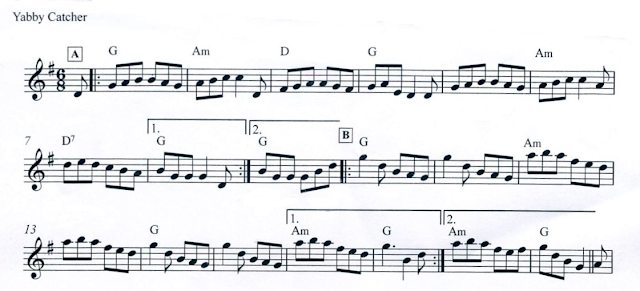
Tune - Yabby Catcher by Maggie Somerville.
~~~~~~~~~~~~~

Dance competition winners  (MW 226, Dec 2014)

General Bush Dance - Bimsey Flyer by John Short

Dancer's dance - Harbour Bridge Quadrille by Keith Wood
Highly commended - Duke's Jig by John Short

Multi figure quadrille - The Mulga Quadrille by John Short

.
~

From the Archives - On the track of the Shed Rep by John Meredith, Parts 1 & 2

Click images for larger size.

Mulga Wire, no. 118, Dec 1996 & 119, Feb 1997


.


.

~


Sunday, 27 February 2022

From the Archives - Parodies, Mulga Wire no. 237, August 2016

Click images for larger size.

Traditional Parody The Dying Fettler (collected in Queensland in 1966), John Dengate's Terrorist Song (written 2003) & Queenslander Jenny Fitzgibbon's Lies Like "Illegal" (tune - When the Boat comes in)


~


From the Archives - Nancy Keesing

Click images for larger size.

Nancy Keesing - Australian Dictionary of Biography  (1923 to 1993) ... In 1951 she began work with the Sydney magazine the Bulletin, where the poet Douglas Stewart had been literary editor since 1940. They had met in 1946, after Keesing had had poems published in the Bulletin and was beginning the close association with Sydney’s literary circles that continued throughout her life. Initially she worked one day a week, carrying out research for a proposed history of the Bulletin, and later assisting Stewart in the preparation of two jointly edited anthologies, Australian Bush Ballads (1955) and Old Bush Songs and Rhymes of Colonial Times (1957). From 1952 to 1956 (the year of the birth of her first child), she worked full time at the Bulletin, also writing many reviews and articles ...

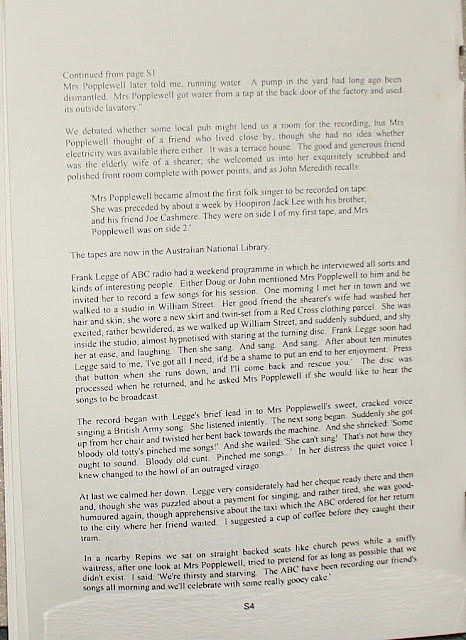
John Meredith met Nancy Keesing at the State Library in 1953 when he was looking for more songs for The Bushwhackers

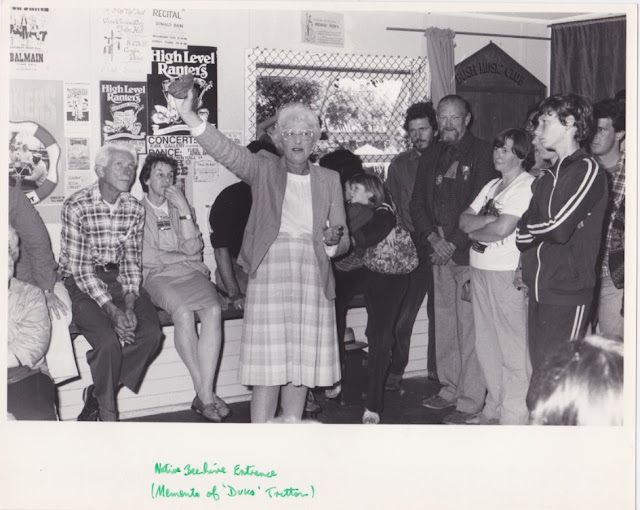
Launch by Nancy Keesing of John Meredith's Duke of the Outback, 1983 Bush Music Festival. Nancy is showing a native beehive entrance Duke gave her.  (Bob Bolton photo) 

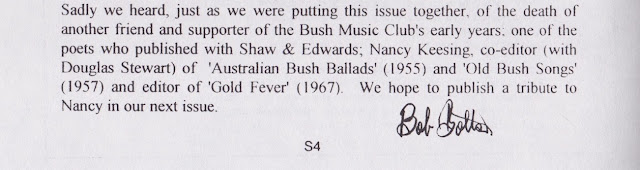
Mulga Wire, no.95, Feb 1993, page S4 

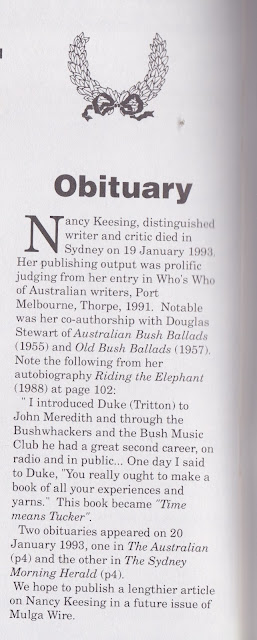
Mulga Wire, no. 95, Feb 1993, p.10

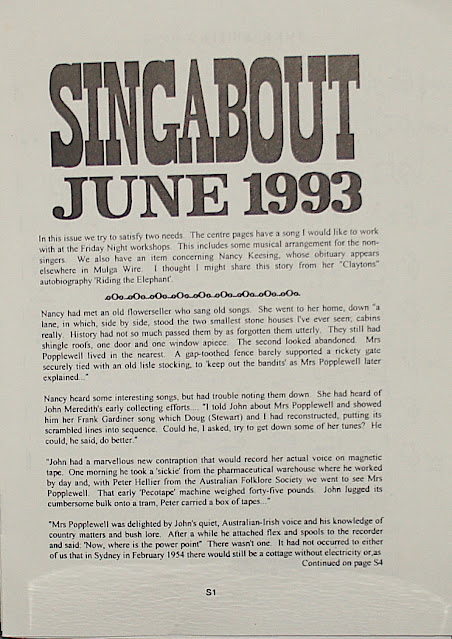
Mulga Wire no. 96, April 1996. pages S1 & S4, 
extract from her autobiography "Riding the Elephant"
about her contact with Mrs Ina Popplewell

.

~


From the archives - BMCs 39th birthday

Click images for larger size.

Mulga Wire no. 117, October 1996

~


From the Archives - Harry Kay

Click images for larger size.

From the Archives - Harry Kay Collection.

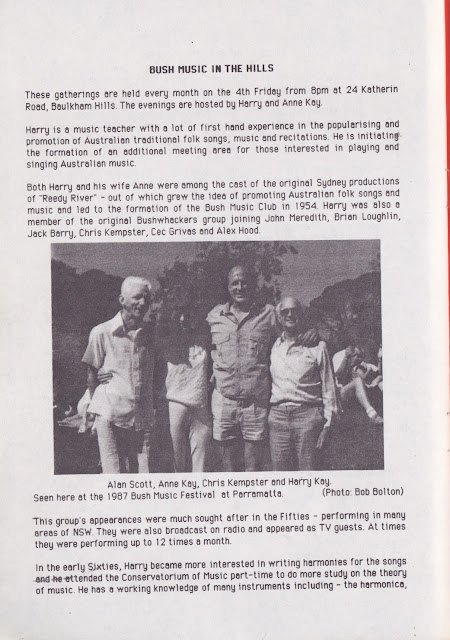
Mulga Wire no. 78, April 1990, Bush Music in The Hills 


.

Mulga Wire  no.109, June 1995 - Some observations on instruments


.


~


Saturday, 26 February 2022

From the Archives - Death of Alan Scott, 17 December 1995, from Mulga Wire February 1996

Click images for larger size.


Bob Bolton's tribute + Publications to which Alan contributed

Dale Dengate's tribute

John Dengate's tribute


An old favourite from Collector's Songbook 

Records on which Alan Scott contributed 


~


Tuesday, 22 February 2022

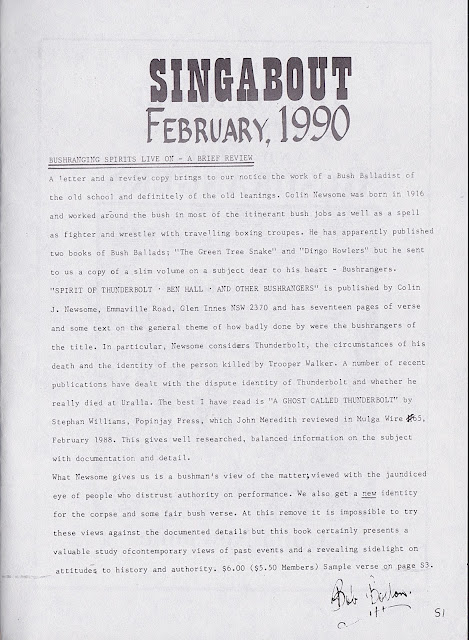
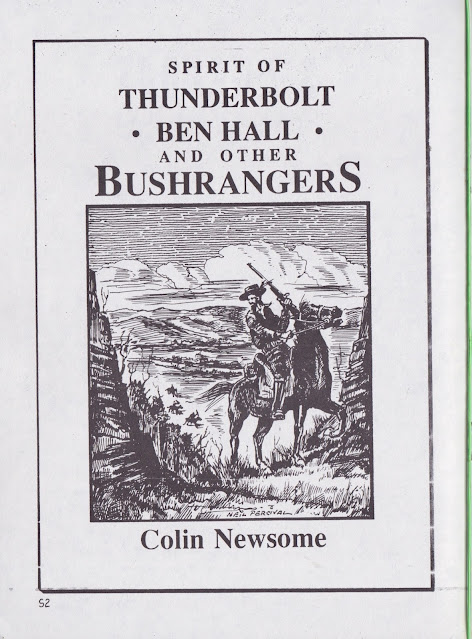
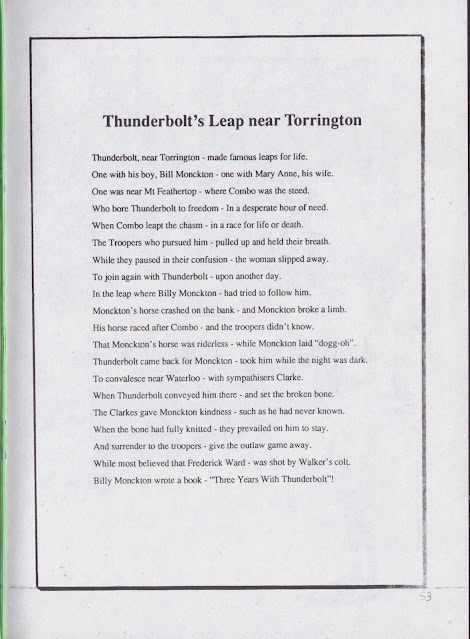
From the Archives - Spirit of Thunderbolt, Ben Hall and Other Bushrangers by Colin Newsome - Review by Bob Bolton

Click images for larger size.

Spirit of Thunderbolt, Ben Hall and Other Bushrangers by Colin Newsome.

A letter and review copy brings to our notice the work of a Bush Balladist of the old school and definitely of the old leanings. Colin Newsome was born in 1916 and worked around the bush in most of the itinerant bush jobs as well as a spell as fighter and wrestler with travelling boxing troupes. He has apparently published two books of Bush Ballads The Green Tree Snake and Dingo Howlers but he sent to us a copy of a slim volume on a subject dear to his heart. 


~


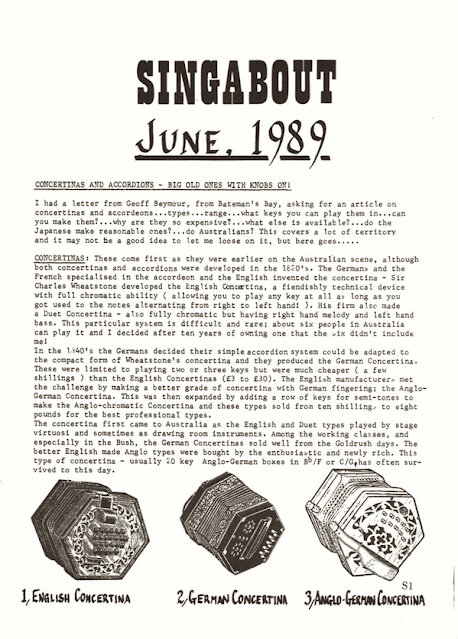
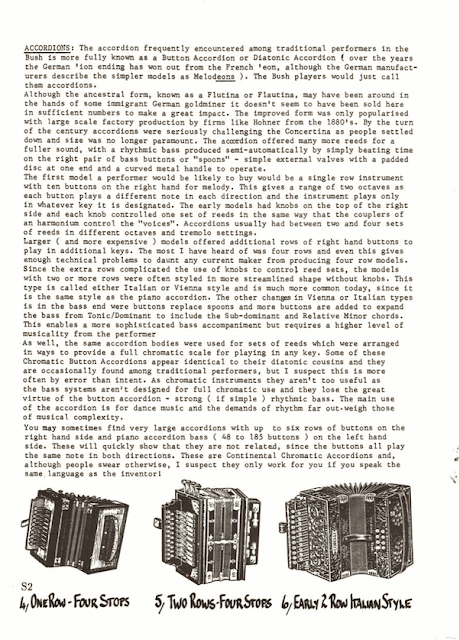
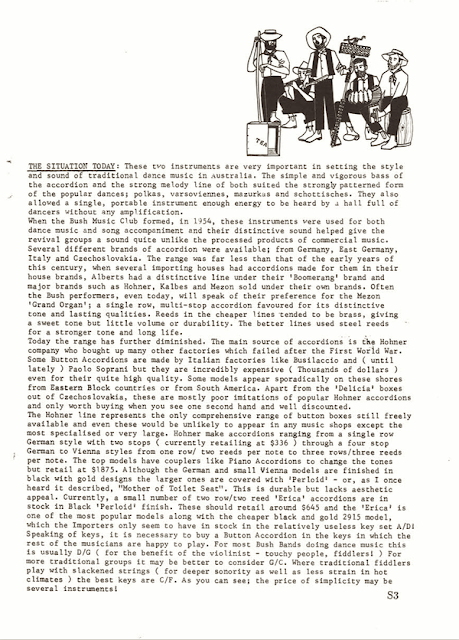
From the Archives - Concertinas and Accordions - Big old ones with knobs on!

Click images for larger size.

Mulga Wire no. 73, June 1989 Singabout article by Bob Bolton


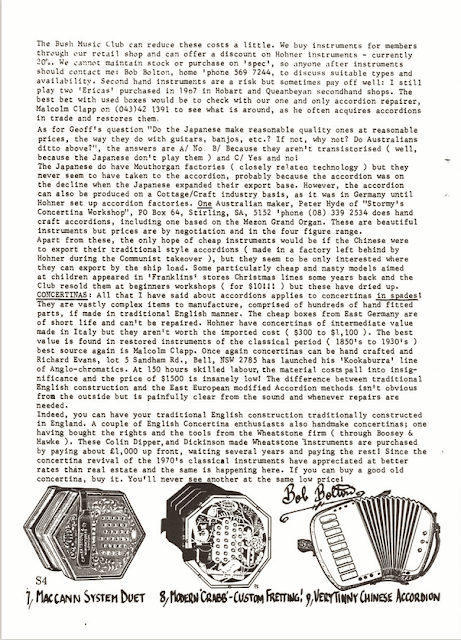
Concertinas and Accordions - Big old ones with knobs on!
I had a letter from Geoff Seymour, from Bateman's Bay, asking for an article on concertinas and accordions ... types ... range ... what keys you play them in ... can you make them?... why are they so expensive?... what else is available? ... do the Japanese make reasonable ones?... do Australians? This covers a lot of territory and it may not be a good idea to let me loose on it, but here goes ...


~


Saturday, 19 February 2022

From the Archives - Forum for Folklore Collectors, University of NSW, 4-6 December 1987.

Click images for larger size.

From the Archives - Collecting Forum December 1987, Mulga Wire no.65, February 1988 

Thanks to Keith McKenry for identifying the photos, email 17/02/22

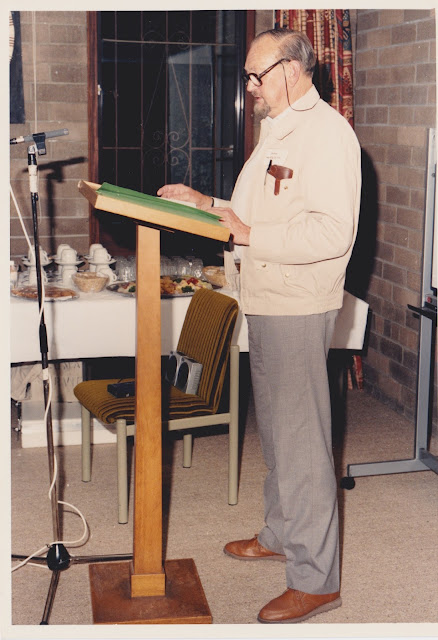
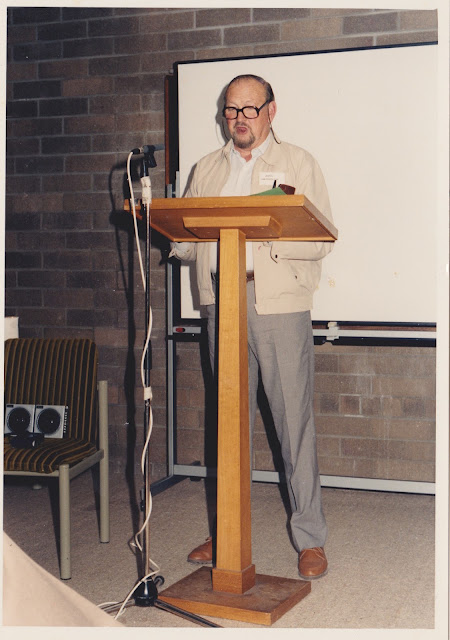
The event was a forum for folklore collectors held at the University of NSW on 4-6 December 1987. The forum was organised by Dr Jill Stubington, lecturer in ethnomusicology in the university's Music Department. Jill later edited a report of the proceedings titled Collecting Folk Music in Australia, which was published by the University in 1989. 
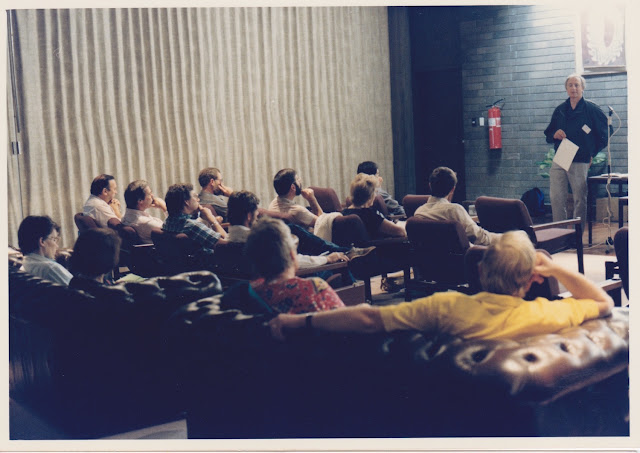

The first photo shows Prof Roger Covell addressing the gathering


The second shows me giving an update on the Folklife Inquiry, whose report was then at the printer
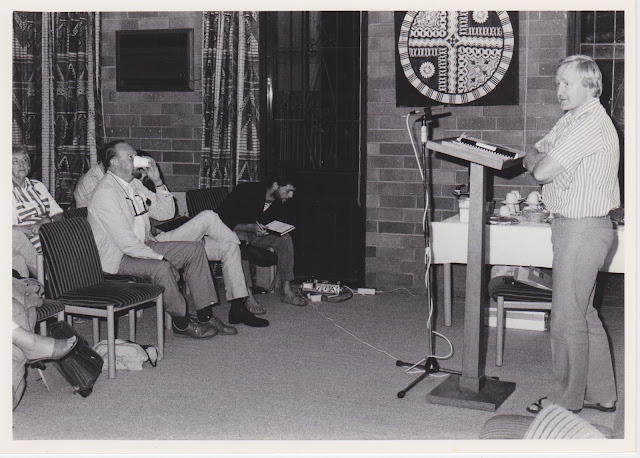

The third shows Jill addressing the gathering. 


The final two photos are of John Meredith delivering the keynote address. In all there were 26 participants. The forum was made possible through a $10,000 grant from the Australia Council's Music Board.

A copy of Jill Stubington's report Collecting Folk Music in Australia. Report of a forum held at the University of NSW, 4-6 December, 1987, in our library.

(Photographer unknown BMC Archives)
~


Sunday, 13 February 2022

From the Archives - Alex Bowker - One of the Older Players by Kevin Minchin, extract from Mulga Wire, no. 47 February 1985

Click images for larger size.

Alex joined the Club soon after it was founded, but the earliest mention of him in our incomplete Membership records is a renewal dated 18/1/66  (ANCOL Index book, Members BMC Bk II). He also seconded a motion at a General Meeting 23/6/62 

Mulga Wire, no. 47 February 1985, pp. 5-7 


~


Tuesday, 25 January 2022

Chris Woodland collection - Reminiscences of the Bush Music Club in the 1960s

Click images for larger size.

REMINISCENCES of the BUSH MUSIC CLUB IN the 1960s.

Chris c. 1963 by John Meredith, published in
Singabout 6(2), 1967, p.10


When did you join?

I think I joined the BMC in late 1962, but am unsure. Perhaps it was 1963. I do remember that in 1963 the Leyland Brothers ran their first TV documentary which was called Down the Darling. Alan Scott was featured singing in the background.

The person to convince me to join the club was Barbara Strain, later to marry George Gibbons. Barbara and I met on the set of one of Edgar Penzig’s films the title of which now eludes me. Edgar had asked me to be the main character as I had been a horseman and, I suspect, because of my suitable age of about 23 years. Barbara was playing the main female character, a lone bush woman who was threatened by an escaped convict. In the end I come galloping through the bush, save the lady, by running the evil intender down and shooting him from the saddle.

At dinner camp Barbara and I had a chat and she asked if I had learnt any de-tribalised Aboriginal songs while I was working in the outback. I said that I knew a couple and she asked if I could come to her place and record them for her. She also suggested that I should join the Bush Music Club and should go along sometime. A couple of weeks after I went to her place to record the songs, where I also met George Gibbons. Following that meeting I joined the BMC. [I suppose this should have been under Why Did I join?]

Why did you join?

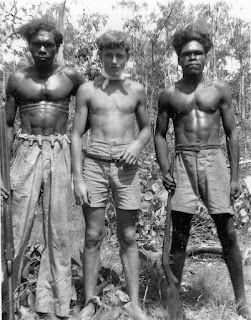
Coming from the parents that I did, I grew up with a strong understanding of how our Australian culture was always overshadowed by the British and how we were made to feel inferior, hence the Great Australian Cringe. I was always interested in Australian songs and poetry, history and geography. In 1952 at the age of almost 15, 7 years after World War 11 ended, I had the experience of a lifetime. My Territorian uncle took me up through outback NSW and Qld - very little bitumen then! – to the Northern Territory and onto Snake Bay, Melville Island where the Tiwi people were still very tribal. My association and experiences with those special people left me with another life-long very Australian passion.

Wilfred, Chris & Len, Tiwi Island


After I had visited the club once or twice, I was outside approaching the building when I heard the most beautiful music, a music which I had never heard before. I was listening to the violin and Uilleann pipes of Barney Heffernan and Billy Crowe. This music must have been in my DNA as it seemed to awaken something within me. These two musicians had been invited along because it was close to St Patrick’s Day.


First impressions?

I was immediately very impressed with the ballads sung there. It also gave me a good introduction to music and musicians. People were particularly friendly and decidedly left wing, which suited my inclinations.

Of course the bush ballads the club members were singing were not the songs that we had been singing outback. Out there were singing Slim Dusty’s When the Rain Tumbles Down in July, Sweeney, Saddle Boy, When the Sun Goes Down Outback etc, as well as the songs of Hank Williams and other American country music singers. On Saturday nights we would sit around the campfire listening to my modern eight-battery transistor to such horribly named stations such as 2WG Wagga’s Riverina Ranch. The most popular request on these stations for ages was Alan Scott singing the Drover’s Dream. I can still recall how we would sit around leaning in then out as the signal faded then strengthened.

Where was the Club meeting?

When I joined it was held on the eastern side of lower Clarence Street in Sydney. I can’t recall the address, but I am sure it is somewhere in other records of the club. The place went back to the horse-drawn days. Facing from the street it had a large door which took up most of the width, with a set of stairs on the right-hand side which led up to the floor above the large area underneath. This area was rented by the Fellowship of Australian Writers NSW. I was excited in this environment, with the writings of Mary Gilmore, Rod Quinn and other renowned writers and poets. The place was very old if not ancient, and I am certain that the floor had a bounce in it of about 2 inches (50 mm) during the dancing.

Workshop Nights? - Meeting nights were really workshop nights. Occasionally a committee meeting would be held to discuss such things as Singabout nights and recording records.

Held where? – Workshop nights were held every Tuesday night. It was held in the Fellowship of Australian Writers room in lower Clarence Street when I was a new member and when I became MC of the club.

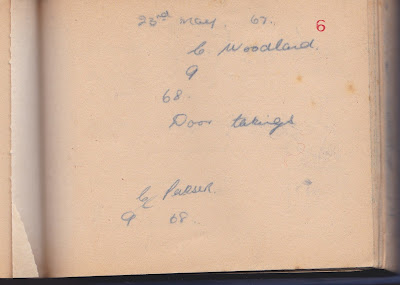
Workshop door takings Tuesday 23rd May 1967


How many attended? – Attendance varied of course, but I would estimate that on the usual evening there would be six or seven musicians and about fifteen or twenty or more adults, and usually a few children.


Structure of night? – I probably followed organising the evening similar to that which Frank Maher had. Frank had been the MC prior to me. We would commence with a few songs which had been selected by me from our Singabout publications and later The Penguin Australian Song Book (1964) by John Manifold. The club had their own copies of these books and would share them around on workshop evenings, collecting them at the end of each evening and storing them in a cupboard for the purpose.

After the few songs we would hold a dance, which was followed by requested songs. Most, if not all requests came from the sources already mentioned. Following the request section (usually ran anticlockwise for some unknown reason!) attendees were given the option of performing their own particular solo numbers. Of course, this is where John Dengate would display his amazing wit and superb songwriting abilities, usually composed through the preceding week.

Another dance then a few more songs. I always finished the evening with what I considered a strong Australian song for the closure. These were songs such as Freedom on the Wallaby or the now politically incorrect Our Fathers Cleared the Bush. Having started at 7.00 pm we aimed to finish by 9.30. If the evening did finish at that time most of the men would walk hastily to the nearest pub as closing time was 10. 00 pm in those days.

On John Meredith’s suggestion I introduced a Beer and Cheese Night once a month. These would be a themed evening such as Lawson, Kelly, St Patrick’s night (in March, of course), Gilmore evenings and others that escape my memory at the moment.

Henry Lawson’s daughter Bertha attended the Lawson evenings. She would have been in her sixties then. Unfortunately she did not contribute to the evening, but we enjoyed having her there.

Performers? – Musicians included older ones like Herb Gimbert (tin whistle, button accordion and swanee whistle), Alex Bowker (mouth organ, button accordion and triangle) and Bill Tovey (button accordion and mouth organ). There was also Harry Glendinning (piano accordion), John Dengate (guitar and vocals), Ken Greenhalgh, Tony McLaughlin (was a multi-instrumentalist, but mainly played the piano accordion), Eric Bolton (on guitar and banjo). The musicians mainly sat to the left of the MC, though some would sit amongst those sitting down either side or across the far end of the rectangular shaped room.

Dances?
– In those days we only had seven dances, which I eagerly learnt and enjoyed calling each workshop night. I would talk through the steps and movements before commencing with me as MC, dancing and calling, throughout the dance. I really enjoyed the calling and dancing. Perhaps if I had joined the musicians I would have improved my accordion playing and developed a better sense of timing. I knew this at the time, but still chose the dancing.


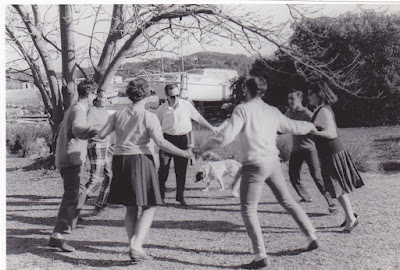
Maher collection - Dance afternoon at Noreen Grunseit's place


The seven dances were:.

Strip the Willow (my definite favourite!)
Haymakers Jig
Circassian Circle
Brown Jug Polka
Virginia Reel
Flying Pieman
Galopede

Singabout Nights? – I only attended a few of these over the years and recall it being held the Sydney Trades Hall in George Street. I think it was sometimes held elsewhere. Venue probably depended on availability on the day. These nights occurred every quarter if I recall correctly.

Held where? As mentioned above.

How many attended?
- Decidedly more than for the weekly workshops. Different faces would appear at these functions.

Structure of night? – A general concert form. The concert party and other members would perform and I think that individual artists would also entertain with a song or two. There were some dancers too, always a favourite with the women, as it was on workshop evenings. As I attended very few of the Singabout Concerts, and I think that they were held on Saturdays when I was usually out of town, my memories are not very strong regarding this matter.

Performers? – Duke Tritton, Silvia and Tom Salisbury, and the Bush Music Club’s Concert Party. Probably the Three Galahs (the Grivas Brothers), appropriately dressed in white moleskin trousers, pink shirts and grey vests). There others whom I can’t recall. Perhaps Jamie Carlin (concertina), and Tony Laughlin performed on these evenings also.

Dances? – Probably the same as on Workshop Nights (see above).

What other activities? – The Concert Party would perform at various locations as invited. Many members, especially the Marrickville Girls (see below), would accompany members of the Wild Colonial Days Society (of which I was a founding member) when they visited country towns to re-enact the centenary of notable or notorious deeds of the 1860 bushrangers. Dressed in colonial attire of those times for the re-enactments also suited the concerts and dances which were often held at these venues.

At my suggestion we visited the Araluen Valley one weekend. My friend Molly Collins, proprietor of the Araluen Hotel, had advertised so widely that the Concert Party had to perform on the main - and only - street!

Year you became MC? – Probably mid 1963. It was not a long time after I first joined. Frank Maher was the MC when I joined and he had had enough of the position and both he and Merro kept urging me to take the position.

Concert Party?
– The Concert Party consisted of John Meredith (button accordion), Harry Glendinning (piano accordion), Eric Bolton (guitar and banjo) and John Dengate (guitar). I think that Tony McLaughlin, a multi-instrumentalist and Ken Greenhalgh (flautist) could have been members also. They could have been casual members as I know that people came and went.

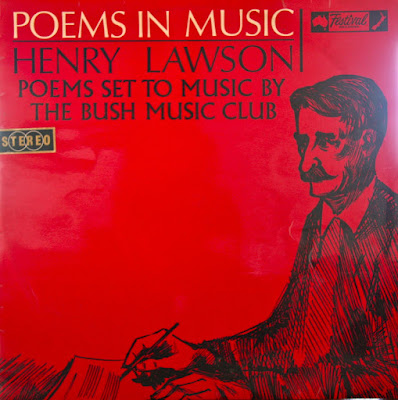
I was never a member of the CP but joined them for the 1967 centenary Lawson album – Poems in Music . I played the mouth organ (the traditional Australian name for the harmonica) and sang. Others on the record were: John Meredith, Harry Glendinning, Brian Loughlin, Frank Maher and Jamie Carlin. It is worth noting that in these years Alan Scott was working night shifts so could not attend Workshop nights. Up until about ’64 Duke belonged to the Concert Party and was a regular attendee.


Other Bands in Club? – In those days members had not formed separate bands as they did later.

Women in the Club? - Pam Loughlin was usually there with her children (Brian was working shift work in those days.) Janet Wakefield, Barbara Gibbons (nee Strain), Dale Morgan (to become Dengate), Rhonda Carlin and the ‘Marrickville Girls’: Sisters Coralie and Evie Baldwin (Australian), Alwena ‘Wenna’ Brooks (Welsh), Rose and Violet ‘Vi’ Jackson (English), Brenda O’Conner (Liverpool, England), Elenor Parker (English) and Caroline Purser from Co Mayo, Ireland. Coralie (deceased) Baldwin married Ray Smith who came along to many BMC workshops (who was also a member of the WCDS), Rose Jackson married Ralph Pride and Morris Matthias (BMC member) married Caroline Purser. Despite an impaired foot Caroline was an accomplished dancer. Some others from the same Marrickville address, whose names I cannot recall, came and went, having been brought along by the dedicated group from Marrickville. Here again it is worth noting that Gay Scott rarely attended because Alan was working night shifts and she had two young sons, Bill and Ashley.

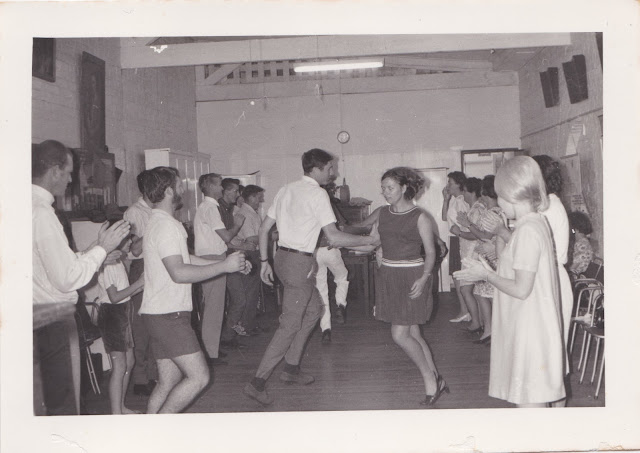
Ken Fairey collection - The lady down the right hand with hand to face,  near the open door, is Welsh and her name is Alwena Brooks, always called 'Wenna' (a Marrickville Girl). It is most likely the girl next to her is another Marrickville Girl, Caroline Purser from Ireland. (Chris)   John Robertson in shorts. John was in Tasmania when Ralph & Rose Pride & Bob Bolton were there. (Ralph & Rose)

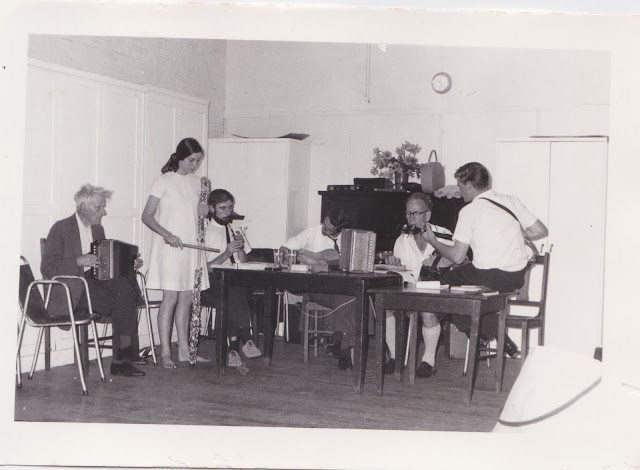
Ken Fairey collection - L-R - Herb Gimbert, Wilma Bolton, Ken Greenhalgh, John Dengate, Harry Glendenning, Eric Bolton. Wilma is using Frank Maher's lagerphone as she did not have one of her own. (Frank)


Children in the Club?
– I don’t recall many children attending the workshops though they would accompany members sometimes. Jenny Loughlin and her sibling were usually brought along by their mother Pam. Bob, then the other Bolton brother were brought along by Eric.


The Folk Revival in the 1960s

Most of the songs we sang came from our Singabout booklets and Manifolds The Penguin Australian Song Book. The most popular song requested by the BMC female members was without doubt Stan Wakefield’s Wallaby Liz. Other popular requests were Five and a Zack, The Broken Down Squatter, Lawson’s The Shearer’s Dream, Freedom on the Wallaby, Cane Killed Abel, The Overlander, Ladies of Brisbane, Stan Wakefield’s The Stock Route Again and innumerable other titles including The Old Bark Hut, Norman Brown, Various songs to the Ten Thousand Miles Away tune, Charlie Mopps (of course!), Maggie May, The Catalpa, Streets of Forbes, some Kelly songs and most of the shearing songs such as The Ryebuck Shearer, Goorianawa and Widgegoara Joe etc.

Was overseas folk music influencing the Club? I cannot recall the singing of any songs that were hitting the airwaves from either Britain or America even though they were gaining popularity with the general populace. After all, we had plenty of good songs to enjoy, protect and popularise!

Others who attended. – Some interesting people attended Workshop evenings at times. These included a chap who was known by the name of Doc (or was it Professor?) who I recall dressed in an impressive manner and performed in a vaudevillian way. His act was playing the saw with a bow. He was very good at playing known tunes. The Doc (or Prof) would turn up probably once every eighteen or twenty-four months.

One bloke turned up only once. He had a reasonable voice, but was a yodeller, a terrible one. Later that evening I asked Jamie Carlin what he thought of our visitor and he said, ‘He was that bad he was good!’

As mentioned earlier, Henry Lawson’s daughter Bertha would turn up once a year once we introduced the Beer and Cheese Night and held our Lawson Night every June.

Chris Woodland, 17 April 2020, (Questions from Kerry Dougherty for Chris Woodland).

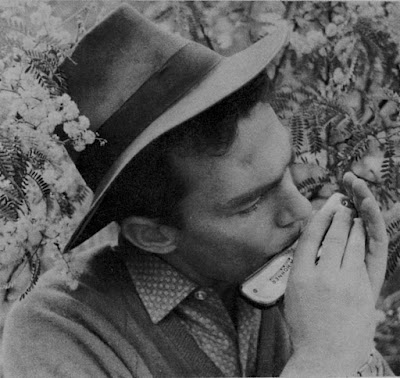
Bob Bolton was introduced to the club by his older brother Eric who had been a member since the early ‘60s like myself. Later Eric would bring along another younger brother whose name now escapes me. Eric played guitar and banjo while Bob played button accordions and mouth organs.

~~~~~~~~