Saturday, 2 June 2012

Early Bush Music Club Days by Frank Maher

Click on pictures for full-screen image


Talks from BMC's 2012 National Folk Festival Themed Workshop on BMC's First 10 years.


The first event I went to was a Saturday Singabout Night held at the Y.W.C.A. on the corner of Wentworth Avenue and Liverpool Street. I worked with Alan Scott at the P.M.G. and he invited me to come along.

Back cover of Singabout Vol. 2, no. 3, Dec 1957

This was in 1955 and as a result I started going every Tuesday to the Workshop Nights which in those days were held at Milsons Point. We rented a room from the Fellowship of Australian Writers. I usually sat in a corner and sang. I was eventually approached by Gay and Alan to join the club as I’d been coming for about a year. I joined in 1956, at about the same time as Duke Tritton.

Frank  Maher, Sam Ramsay, Alan Scott,  Jamie Carlin 
(Ann and Frank Maher Collection, undated) 

Tuesday nights consisted of going around the room and everybody contributing an item : singing, playing or maybe a recitation. Then we would go to the latest Singabout magazine and learn some of the new songs. After interval there would be request time for songs from earlier Singabout magazines, and also bush dancing.

 Singabout Night at BWIU. Ann in shawl, Frank with money tin.
(Anne and Frank Maher Collection, undated)  

After we had moved with the Fellowship of Australian Writers to rooms in Clarence Street in the city, Noreen Grunseit joined us on Tuesday nights and taught us some new dances. Coffee at Repins in George Street became the traditional end to the night. The beauty of Tuesday workshops was that they were held every Tuesday, not once a month, so you didn’t need to think which Tuesday, just turn up, which I did for many years until the move to Marrickville.

 Dancing in Noreen Grunseit's backyard. (Ann and Frank Maher collection, undated)

As a consequence of knowing all the words I was invited to join the Concert Party and my first away engagement with the group was to Orange for the Banjo Paterson Festival. Members at that time were Gay and Alan Scott, Jamie Carlin, Jack Barrie, Jan Jones, Sam Ramsay and myself. Jan had been teaching me to play bones and lagerphone.

Concert Party at Orange at Lake Canobolas Regatta, Banjo Paterson Festival - 
Jamie Carlin, Jan Jones, Frank Maher, Gay Scott, Alan Scott, Jack Barrie, 1960
(BMC archives)

We used to dress for these occasions: Girls : long skirts usually blue and long sleeved white blouses. For the boys : moleskin trousers, long sleeved shirt and waistcoats. Also hats and elastic sided boots.

Some members decided that Sam didn’t look knock about enough and wanted to alter his collar. Sam refused and he and I moved off together, with the others coming up in the rear. We got to where there was an art show with two women out the front with a cash box charging to go in. We heard one women say to the other: “Put away the cash, Gladys. Here come the gypsies!”

With the Concert Party our biggest audience ever was a performance at Bringelly for a World Jamboree of Scouts. There were 5000 Scouts in the audience.

The role of MC at the Tuesday night workshops was shared over the years by John Meredith, Alan Scott, Jamie Carlin, Rex Whalan, Chris Woodland and myself.

 Mug given to Chris Woodland when he left his role as MC in 1968
(Chris Woodland collection)


Singabout, Vol.6, No.2, 1967 (BMC Archives)

Singabout nights were held on Saturday nights every 3 or 4 months at the B.W.I.U. Hall in George Street. This was a family night and and regular invitations to perform were sent to Silvia and Tom Salisbury, Coral and George Daseyand Denis Kevans. We would operate the Concert Party around these entertainers and Ronda would put on the supper which was the best in Sydney considering that the entrance fee was only two shillings. 

 Collection of Ann (nee Banks) and Frank Maher
  
One day in the early sixties Dale Dengate introduced John to the Bush Music Club. He wrote songs all the time and was invited into the Concert Party as second guitarist to Sam Ramsay. We had just done a gig at the I.O.O.F. Hall and I told Sam that the next date was in a fortnight’s time at the Y.M.C.A. I think that Sam got his initials mixed up and ended up again at the I.O.O.F. As Sam was getting married shortly, he dropped out and John was elevated to lead guitarist.

 John Dengate, Singabout 1966 (BMC Archives)

We celebrated our 10th birthday in 1964 with a variety of concerts, and also a family weekend away at Currawong on Pittwater where amongst campfire cooking, singing and dancing, club member Brian Loughlin led a discovery bushwalk to the Aboriginal rock engravings.


 Brian Loughlin, from 1957 picture of The Bushwhackers 
(BMC Archives)


************************************************************************************************* *************************************************************************************************


Bill Scott's talk about his parents Alan & Gay Scott

Click on pictures for full-screen image
 Talks from BMC's 2012 National Folk Festival Themed Workshop on BMC's First 10 years.

I’ve been responsible for a few truly dreadful renditions of some songs in my time, but I’ve also come up with a few okay ones (at least considering the amount of time I went to practising them.) Thanks to my parents, I had a completely painless musical education that stands me in good stead to this day; it began when I was going to sing-alongs in the womb, and never really stopped.

When we were kids, Dad had his reel to reel tape player and one of my inexhaustible supply of uncles four or five hundred miles north had a four track. Come early December Mum, Dad, my brother Steven and myself would start singing a whole bunch of Christmas carols and, once we got them right, we’d record them and send the tape off to Queensland for Grandma, Uncle Dave, Uncle Bill, Aunty Esme and the rest of the gang to listen to. Uncle Dave would send the tape back in January. (Magnetic tape was expensive. My honorary uncle, John Meredith, once described recording watching the tape counter as if it was the meter in a taxi ticking over).

There weren’t any singers in the family up there at that time. I imagine all Uncle Bill’s creative energy was being soaked up by the novels he was writing, so Uncle Dave would record a spoken word letter filling us in on the latest developments in the extended family. It was during one of these letters that we found out that Uncle Dave had more than just a mono tape machine. He hadn’t taped over our singing to record his letter. Instead, he’d added the letter as another track. At one point, he described a succession of deaths, accidents, illnesses and sundry bad news to a series of rousing songs of hope and joy lustily executed by the New South Wales Scott family in full flight; Dad with his stylish steady tenor, Mum who had this knack for communicating liveliness. (I’m not sure how she did this much of the time. She studied acting for a year or more so there was a lot of technique and nurture going into it, but sometimes I got it like, for instance, when she ended a verse with a harmony most of the way up the octave from the basic tune to give the chorus that bit more oomph.) And, of course, Steven and I would fill up the soprano/falsetto bandwidth, figuring we’d have to sing awful loud so that Grandma could hear from all those miles away.


(Scott family album)
Mum and Dad didn’t have much to do with the folk scene during most of my brother’s and my childhood because we were two hungry mouths to feed and there was a ravenous mortgage to provide for as well. I remember one weekend afternoon when Dad had a bit of time to spare between overtime and nightshift. He picked up the concertina and ran through a sailor’s song. Half way into the second verse Steven decided to lose it in a big way and tell mum he wasn’t going for his nap. He ended up howling racking sobs, drawing ragged breaths, lying on his stomach beating the floor with his fists. Dad, unperturbed, sang his way through the scene although he did, eventually, change the words of the chorus from “don’t cry little fishy” to “don’t cry little Stevie.”

I’m really proud of the songs Mum and Dad nurtured over the years and fascinated by the different versions of them that I’ve heard from several generations of performers - from the really early stuff held in the National Library, collected by Dad, John Meredith and others, through the electric Bushwackers, Jason and Chloe and the amazing line up of performers who just keep coming. For instance, the Banks of the Condamine can be tragic or comic. Frank the Poet’s Morton Bay can be a lament or a bitter rant. Which tune for Waltzing Matilda - Who’ll be a Soldier for Marlborough, or the Queensland version? How maudlin can you get Little Fishy to sound at three in the morning after way too much grog? Thanks to everyone for recognizing mum and dad’s contribution.


Article from Singabout, Vol.3, no.2. Autumn 1959 (BMC Archives)


(Alex Hood & Bill Scott, NFF 2012 - Sandra Nixon photo)

*********************************************************************************************** **********************************************************************************************

Sunday, 1 April 2012

Who we are

The Bush Music Club Inc based in Sydney, was founded in 1954 and is Australia's oldest folk club. 
It is the second oldest known Folk Club in the English-speaking world.


History of the Bush Music Club from our website


Click on pictures for full-screen image

In the beginning ...

The club was founded in 1954 by a mob of mostly bush types that found the jobs had all moved to the city. They missed the friendly, informal social life they remembered from the country towns where they grew up.

They formed a band, which they called the Heathcote Bushwhackers, sang some of the old songs, and played such simple instruments as the squeezebox (button accordion) and whistle. As a group they became involved with the New Theatre, supplying the musical side of Dick Diamond's new Australian musical play Reedy River.


Musically inclined theatricals joined the band (now just called the Bushwhackers) and membership rose to seven. The band now played accordion, guitar, banjo, mouth organ, tin whistle and those distinctive home-made instruments; bush bass, bones and particularly the lagerphone - which the Bushwhackers first introduced to the public.


Seeking more songs and Australian historical background, they became involved in the Australian Folklore Society and John Meredith started using the new-fangled tape recorder (twenty kilograms of mains driven bulk in those days) to get down authentic items from old performers. The material collected was translated into the Bushwhackers' repertoire as fast as they could learn it. The shape, size and style of the Bushwhackers provided a model for every revival bush band since.


And then ...

When more and more people wanted to join the they decided to form a social, teaching club, founded at a meeting on 14th October 1954, and called the Bush Music Club in honour of the survival in bush areas of that style of self reliant entertainment and sociability that seemed so scarce in the "big smoke".

At the Club, people could learn the newly collected traditional songs, get tips on playing (and making) the "bush" instruments of the Bushwhackers and form their own bands (collectively known as Bushwhacker bands in those heady days). Eventually, similar clubs started in other states, complete with their own bands such as the Moreton Bay Bushwhackers and the Port Phillip Bushwhackers.
In 1955 the Bush Music Club started publishing the collected songs and music in its own magazine Singabout, the journal of Australian Folksong. The Club's present, two-monthly magazine Mulga Wire deals with the social aspects of the present-day organisation, reviews and events but Singabout continues as a folklore section within the magazine.


And so to publishing ...

In the early days of the revival, Singabout was the only regular journal for publication of songs and music recorded by the pioneer field collectors. The Wattle Records releases of The Bushwhackers and the early Festival recordings of the BMC Concert Party were among the first performances of revived Bush songs heard by the public.


Only in the mid 1960s did mainstream publishers like Ure Smith risk bringing out books like the classic Folk Songs of Australia, by John Meredith and Hugh Anderson. Of course, by the 1980s, these works had such academic standing that Folk Songs of Australia was republished by New South Wales University Press - as a companion to volume two, by John Meredith, Roger Covell and Patricia Brown.

Meanwhile the BMC carried on, well to the side of academic fashion, with publications aimed at helping and informing musicians and dancers out in the folk world. A landmark publication, in 1984, was David Johnson's Bush Dance (tunes), which became one of the hardest working source books for bush bands all over Australia. When teamed with the later Bush Dance (instructions), by Lance Green et al, and the ten Bush Dance tapes, we had probably the most complete integrated package of bush dance material available in Australia.

Our recognition of the important seminal role of Singabout magazine led to the 1985 anthology Singabout - Selected Reprints. This presents 86 songs, 8 poems and one yarn, agonisingly selected as the best, from the host of beaut material published over the 12 years of Singabout.


**************************************************

Welcome

Welcome to the Bush Music Club's blog!

Here we'll be posting historical & current information 


Friday, 1 December 1978

From the Archives - Mulga Wire no.10, December 1978 + 1978 calendar & 1978/79 revised calendar

Click images for larger size.


1.


2.  Editorial.


3.  Meet the Poets, no. 3, Banjo Paterson, by Barry Collerson, pp.3-4


4. Record Reviews - On the steps of the Dole Office door: Oral images of the Great Depression in Australia. Larrikin Records: LRF 015. (R.L.B. Bob Bolton)   pp. 4-5


5. Record reviews - Billy of Tea, Warren Fahey & the Larrikins. Larrikin records : LRF 028.  (R.L.B. - Bob Bolton)
Book review - Then Bushwackers Australian Song Book, ed. by Jan Wositzky & Dobe Newton.  (P.S.)


6.  Dance Workshop.  Australian Traditional Dance Group.  Reedy River  at New Theatre from January 6th 1979. Friday Workshops.


7.  Singabout.  Ball's Head Campfire.  Ryebuck Bush Band.  Rouseabouts Rattle on ...  Reedy River Bushmen


8.  Sydney Festival of Folklife. New Year Revels at Hill End '78 - '79.  Mudgee Schottische Transcribed from the playing of Jamie Carlin


9.  New Year Revels at Hill End Historical Site.


10. Larrikin Records.


11. Christmas Party


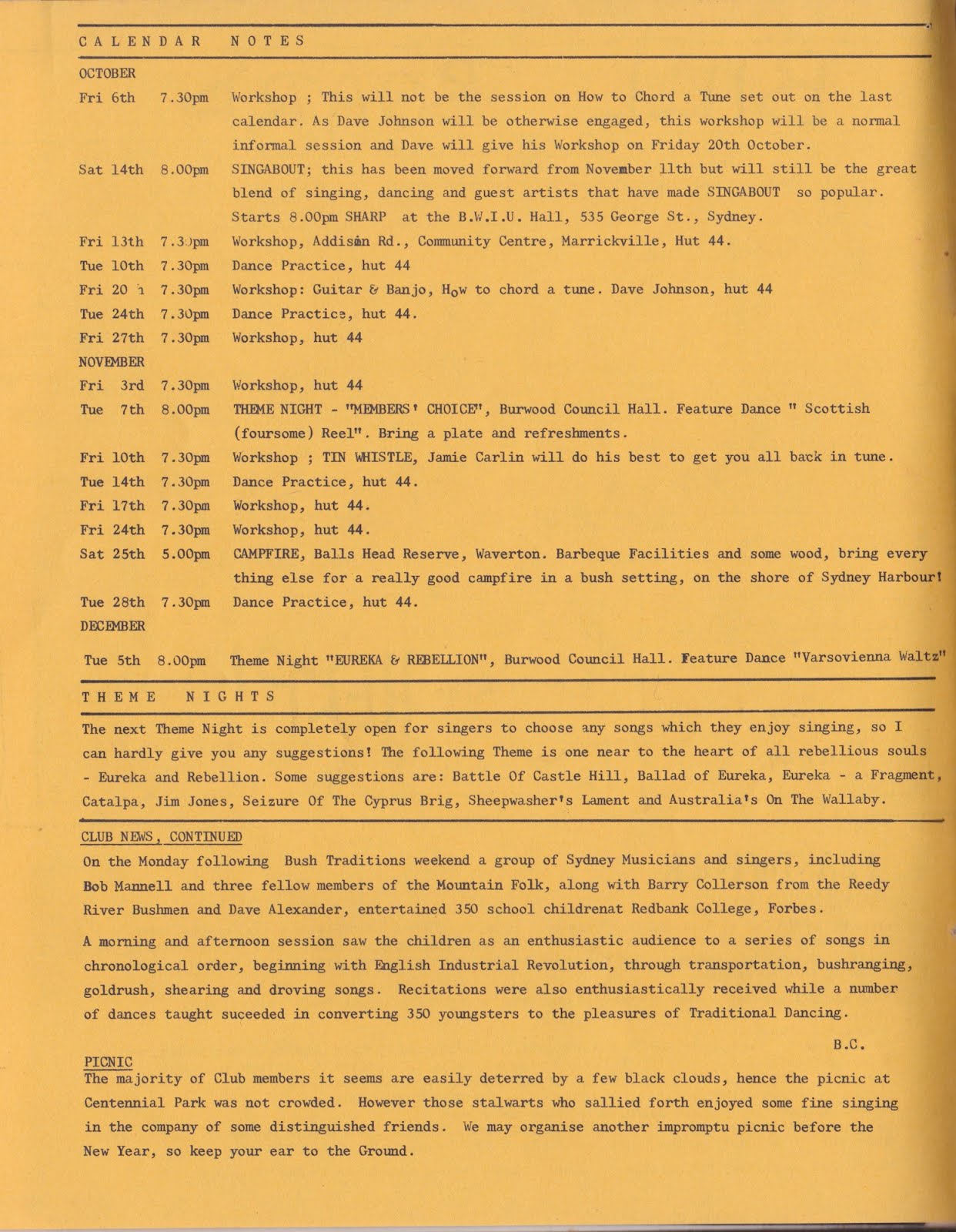
12. Bush Music Club Calendar Notes. Australia Day Dance.

13. Here we are again. Still going strong, but with a quite different look to this year's calendar. If you are a member, you will receive this as an insert into your copy of "Mulga Wire" our new Club news magazine which commenced last year to brighten up our newsletters. 

14.

15.

16.

17. New premises, new types of activity, best of all, lots of new faces. One of the results of all this activity is we have run out of 1978 Club Calendars


18.

19.

20.


Sunday, 1 October 1978

From the Archives - Mulga Wire no.9, October 1978 - complete

Click images for larger size.


1.  Cover by Raema Grieve.


2.  Editorial.  Singabout Saturday 14th October 78.


3.  Talking with Shirley Andrews, pp.3-4


4.


5.  Meet the Poets, number 2. John O'Brien (P.J. Hartigan) pp.5-7


6.


7. Meet the Poets. Rouseabouts (That Rattling Good Bush Band ... Remember?)
  Reedy River Bushmen.


8. First Colonial Subscription Ball.  Australian Traditional Dance Group.  Concert Party.


9.  Dance Workshop.  Lachlan Vintage Village Bush Traditions 1978.


10.  Larrikin Records.


11.  Bill Board. 1979 Festival of Folklife.


12.  Calendar Notes.

~~~~~~~~~~~~~~~~~~~~~~~~~~