
A three-part article in Mulga Wire, 1980-81 (citation below)
When Jack Lang published his memoirs at the age of ninety a reviewer pointed out that we had to take his word for what had happened; there was no one else left who had lived through the events. I don’t want to wait that long to describe the beginning of the Bush Music Club, but others may recall things differently. I remember clearly my first involvement with what led to the formation of the Club. Early in 1954 I was in Sydney to attend a Youth Conference and one Saturday night Gay Terry and Lorna Lovell took me to see a musical play called Reedy River. I was enthralled and when it was over I clapped and cheered and howled for more. So did the rest of the audience.

1. Reedy River (BMC Archives)
Kev and I were talking on the footpath when Brian came dancing out humming the Cossack Dance from the Nutcracker Suite and clicking his heels in the air. (This was the same milk bar where Kevin and a mate, being broke, once asked for a glass of water and two straws. It says a lot for the Loughlin personality that they got it!)
Well, Brian showed me the Lagerphone and introduced me to the Bushwhackers, who played and sang in Reedy River and performed separately as a group.

2. Brian O'Loughlin's Lagerphone 1956 (BMC Archives)
“Your Uncle Raleigh used to play the tin whistle,” my mother told me, but Uncle Raleigh was dead. “Your Uncle Will used to play the squeeze box,” Mum said, so I went to see Uncle Will. He got his accordeon off the top of the wardrobe, where the hornets had built mud nests on it, but he had suffered a stroke and couldn’t pump the bellows. Mum could remember her brothers beefing out The Wild Colonial Boy on the front verandah when she was a girl but didn’t recall words or tune; so I had to come to Sydney for the Bush Music.
Arriving in late July, I contacted Merro and became a twenty four year old groupie, turning up wherever the ‘Whackers’ were performing. They soon got tired of looking at me in the audience and asked me to sing on stage with them. Once I went to a party instead of a Bushwhacker engagement and the next time I saw Merro (I remember it was in a pub) he talked very seriously about the dedication of the Band and their self imposed discipline. It looked pretty bad, he said, when someone went off to a party instead of turning up at a performance. At length it penetrated my dim brain that I was part of the Band. A Bushwhacker! And I hadn’t even noticed!

(Part Two: Picking up where Alan Scott unexpectedly discovered that he was a dedicated member of his dream group ; The Bushwhackers.)

4. Jack Barrie (BMC Archives)

5. Brian Loughlin, 1957 (BMC Archives)

6. Alan playing nose flute (BMC Archives)

7. Bushwhackers playing at Lawson's Statue, Botanic Gardens Sydney (BMC Archives)
We went to Pagewood for four days of boring inactivity and a couple of hours’ work in the film Three In One.
The ‘rushes’ of this showed us capering round on a small bright viewing screen without sound. We looked so good the director decided to use Chris and Brian further in the film. We played in false whiskers to thousands of kids at the Showground for the Smith Family. The kids wanted to tear our beards off and we got our picture in the Herald again. We played at an RSL dance at Dee Why, where I saw my first poker machine.
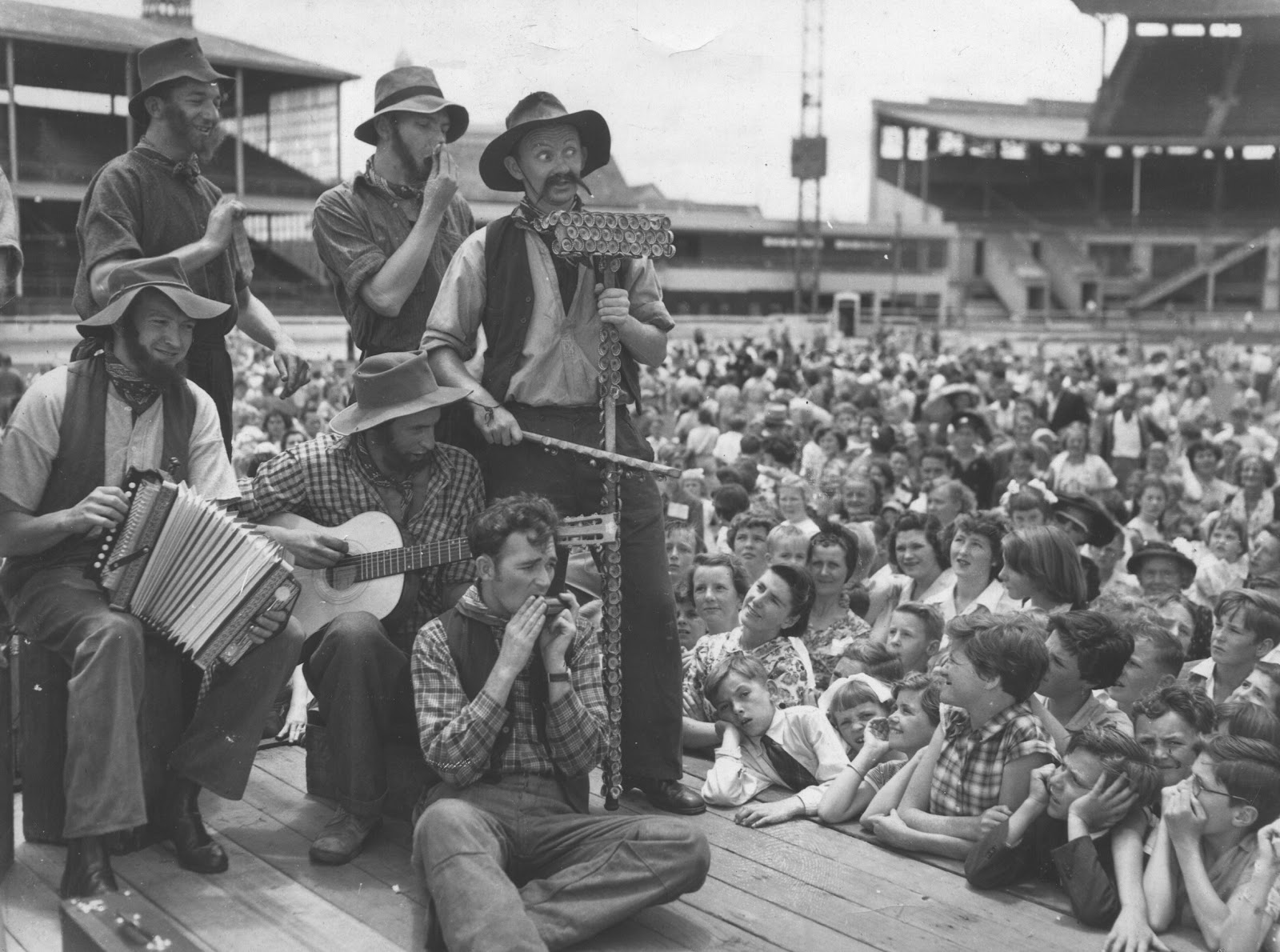
8. Bushwhackers at the Showground for The Smith Family (BMC Archives)
(Part Three: In which Alan Scott finds playing with his dream band is very hard work.)
During Wool Week we were employed by David Jones to play for customers in their different stores. The illustration that appears on the BMC letterhead originated then as a newspaper ad. for DJ’s.

We visited some country towns for different functions. We went down a coal mine at Lithgow and broadcast live over the radio station there where I forgot the words to Drover’s Dream We saw the Hunter River in full flood at Newcastle, put on a concert in Mudgee Town Hall and saw the remains of the Lawson Cottage at Eurunderee.
The Bushwhackers were notably untemperamental but by 1957 our constant association, instead of wearing away our differences, was working to sharpen them. Not all of us realised this or how often Brian’s diplomacy was exercised to smooth things over. A perennial point of difference was the question of singing in harmony. The advocates of this saw it as a way of making our renditions more musically attractive and reviving our (by now) sometimes jaded performances. The majority rejected it but the idea kept coming up with unwelcome persistence. This was a time, too, of turmoil in the Communist Party - there was only one in those days! I remember Brian being asked, “Are you for Kruschev or Stalin?” and his classic reply, “I’m for Marx!”.
***************************************


